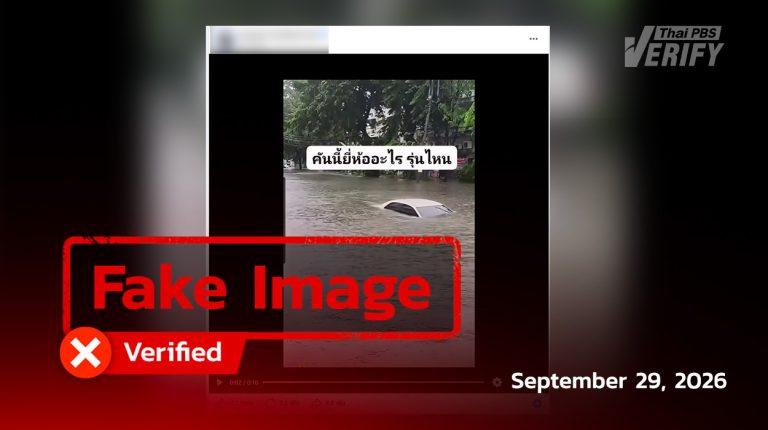
Clip of Car Driving Through Deep Floodwaters Submerged Near Roof Level Revealed to Be AI-Generated
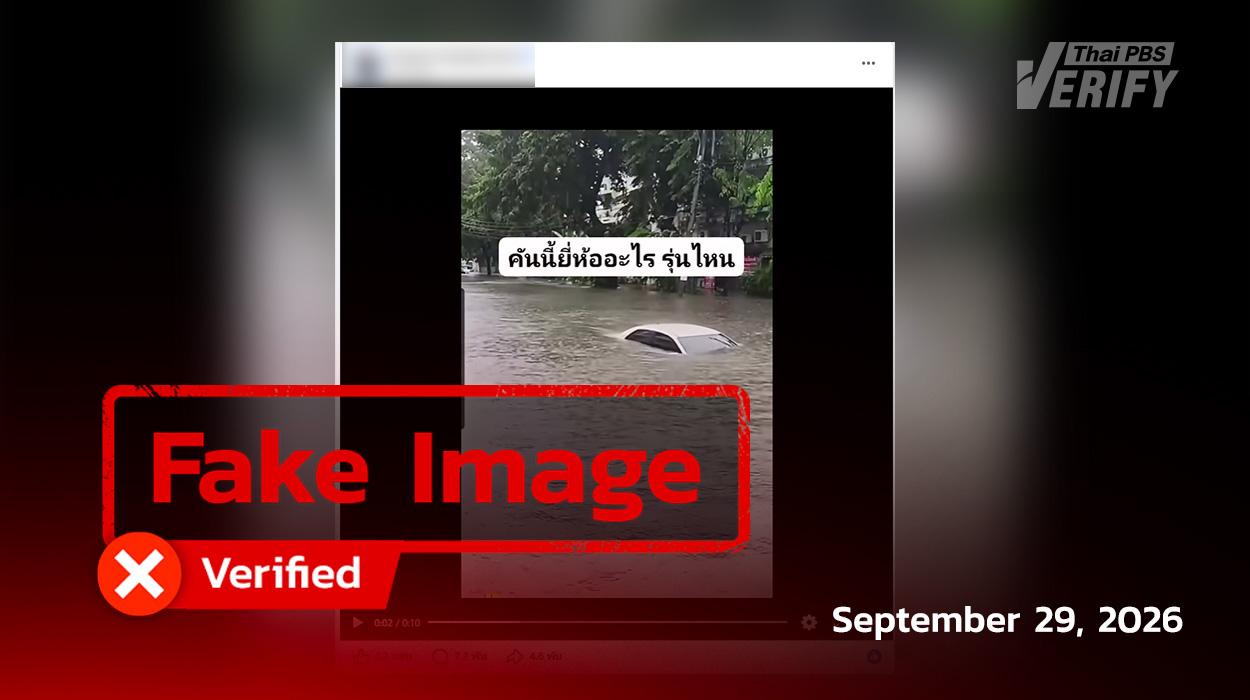
Thai PBS Verify found the source of the fake image from: Facebook
Thai PBS Verify found a Facebook account sharing a video clip of a car wading through floodwaters with the caption: “What make and model is this car?”
The post ammassed 7,400,000 views, 120,000 reactions, and 7,200 comments, with the majority of commenters believing the car could genuinely navigate deep water and inquiring about its model, alongside over 4,600 shares. It was posted on September 26, 2026.
Is this video clip real?
Thai PBS Verify analysed the video clip using AI media detection tools such as Meta AI identification and Hive detect, confirming that the clip was generated by AI.
Specifically, the findings noted: “Meta tools detected metadata indicating this media was “Created using Generative AI”, with the system stamping the creation time as September 4, 2026, at 09:37 UTC, categorized under ‘Media Generation & Editing.’”

Identify results by website Meta AI identification

Identify results by website Hive detect
When the screenshot was examined using the InVID-WeVerify image analysis tool, it was found that the text on the building in the clip could not be identified as belonging to any particular language. These observations indicate that the footage was AI-generated.
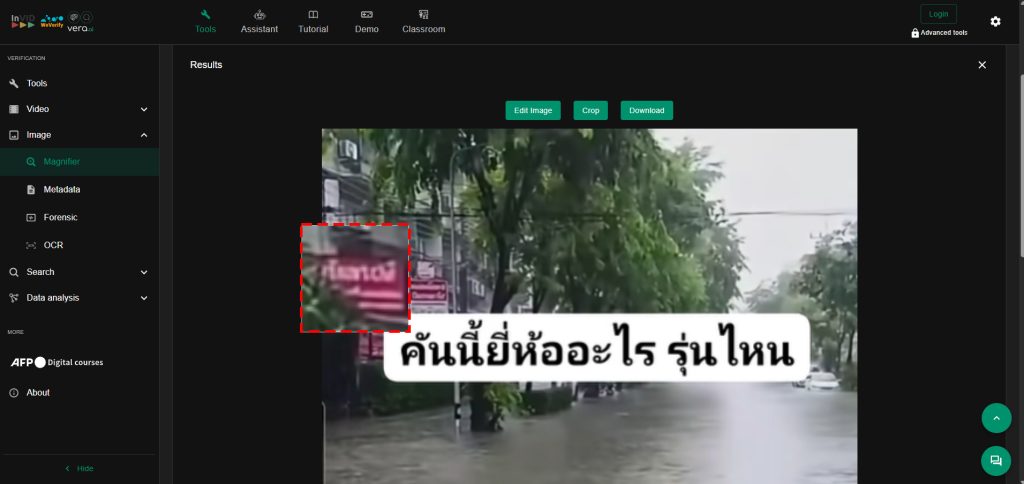
Image showing an analysis using the InVID-WeVerify image verification tool.
Safe Driving Practices for Flooded Roads
Mr. Pattanadesh Asasappakij, an automotive expert, told Thai PBS Verify that drivers should thoroughly assess water depth and road conditions before attempting to drive through flooded areas. If floodwater rises above mid-wheel height, or reaches or exceeds the hood level, it poses a severe risk, and drivers should refrain from entering.
If navigating through water is unavoidable, shift into low gear, maintain steady engine RPMs, and drive at a low speed. Avoid sudden acceleration or hard braking, and refrain from making frequent speed adjustments or sharp steering maneuvers, as these actions can cause the vehicle to lose control.
Regarding the air conditioning system, if turning it off becomes necessary, lower the windows slightly to assist with heat dissipation and reduce windshield fogging. If keeping the air conditioning on, avoid running the fan at maximum speed to prevent excessive intake of outside air.
After clearing the flooded stretch, tap the brakes gently several times to expel water from the braking system and restore normal brake pad performance. Should water enter the cabin or engine bay, shut off the engine immediately and do not attempt to restart it. Doing so can draw water further into the engine, causing “hydro-lock” and severe mechanical damage.

Mr. Pattanadesh Asasappakij, an automotive expert.
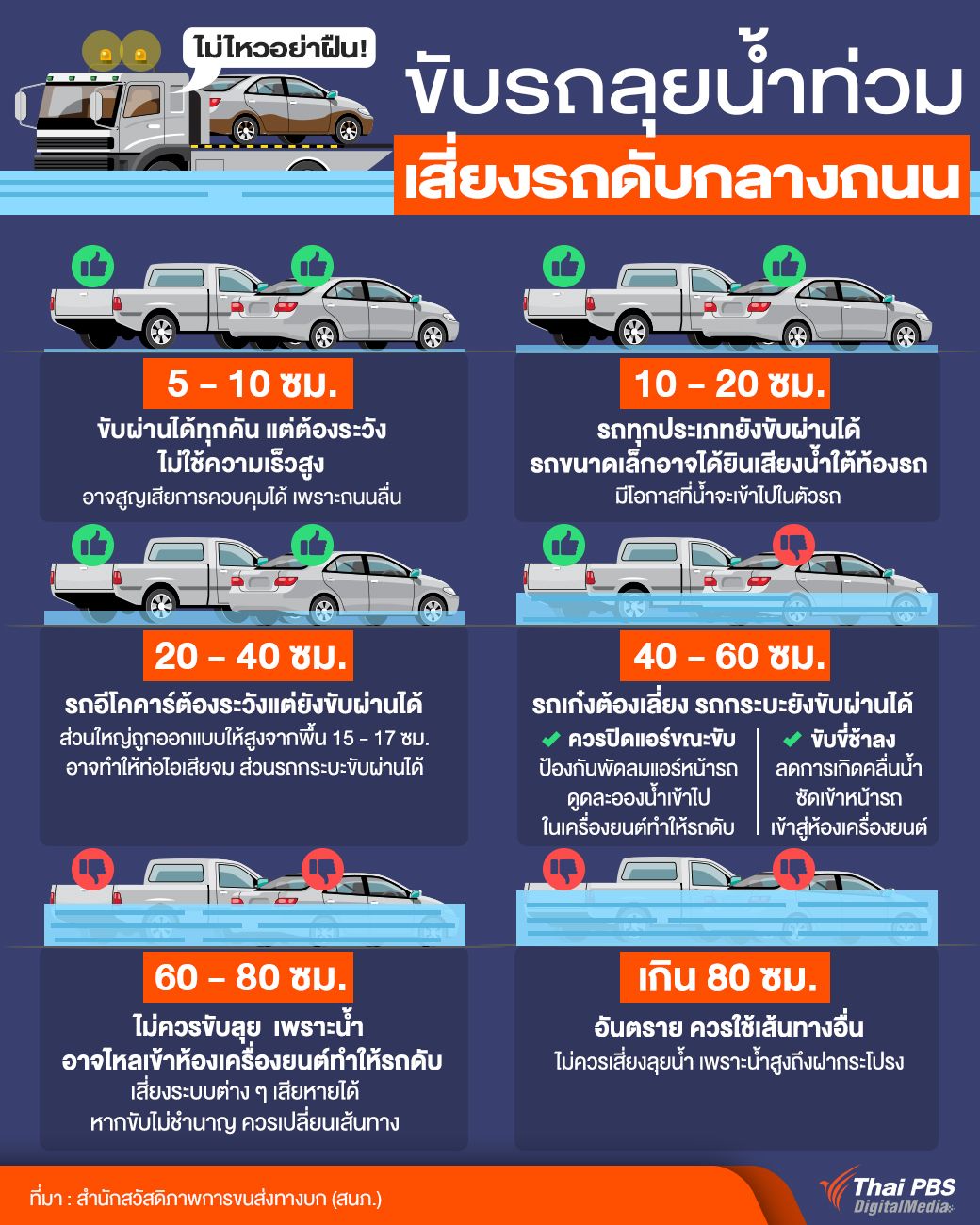
What Flood Levels Are Too Dangerous to Drive Through?
Navigating flooded roads poses severe risks to both a vehicle’s engine and its onboard systems, particularly as water levels rise. Drivers should carefully assess water depth and route conditions before proceeding to minimize the risk of stalling mid-route or causing damage.
- Water depth 5–10 cm: Safe for all vehicle types to navigate. However, drivers should exercise caution and avoid high speeds, as wet road surfaces can cause loss of control.
- Water depth 10–20 cm: Traversable for all vehicle types. Compact cars may hear water splashing against the undercarriage, so exercise heightened caution because water could enter the cabin.
- Water depth 20–40 cm: Eco-cars require extra precaution, as most feature a ground clearance of approximately 15–17 cm. Rising water may reach exhaust pipe level, though passing through remains manageable. Pickup trucks can clear this depth without issue.
- Water depth 40–60 cm: Sedans and compact cars should strictly avoid driving through. Pickup trucks can still pass, provided drivers turn off the air conditioning to prevent front cooling fans from drawing water spray into the engine bay, which could cause engine stalling. Drivers should also reduce speed to minimize bow waves from oncoming or neighboring traffic splashing into the engine compartment.
- Water depth 60–80 cm: Vehicles of all types should refrain from driving through. At this depth, water can easily enter the engine compartment, causing the engine to stall and inflicting widespread damage across mechanical systems. Driving through water at this level demands specialized handling and requires avoiding direct impacts from incoming waves.
- Water depth exceeding 80 cm: Do not attempt to drive through under any circumstances. Seek alternative routes immediately.
Source: Department of Land Transport’s Bureau of Transport Safety
What is the truth ?
Thai PBS Verify verified that the clip of a car driving through deep floodwaters shared on Facebook is an AI-generated video, not an authentic event. Detection tools from Meta flagged the content as having been “Created using Generative AI,” categorizing it under “Media Generation & Editing.” Meanwhile, analysis using Hive Detect confirmed that the media was generated by AI.
Despite the clip drawing substantial view counts and high engagement, the visuals should under no circumstances be used as a real reference claiming that this vehicle model can actually navigate deep floodwaters. Drivers must carefully assess water depth and road conditions before taking action, strictly avoiding driving through high water levels or high-risk areas.
Verification Process
- Analysis using AI video detection tools: Evaluating the video through AI identification tools, including Meta AI Identification and Hive Detect, confirmed that the clip was created using AI. Meta explicitly flagged the content as “Created using Generative AI,” categorizing it under “Media Generation & Editing.”
- Verification through expert sources: Thai PBS Verify interviewed Mr. Pattanadesh Asasappakij, an automotive expert, who advised assessing water depth and road conditions before driving. If floodwater rises above mid-wheel height or reaches hood level, drivers should refrain from entering. If navigating through water is unavoidable, shift into low gear, maintain a slow speed with steady engine RPMs, tap the brakes gently several times after clearing the water, and shut off the engine immediately if water penetrates the engine bay, avoiding restarting the vehicle as this can draw water in and cause severe damage.
Impact of Disinformation
- Misleading the public into believing that motor vehicles can navigate floodwaters in the way depicted in the clip.
- Encouraging motorists to emulate the behavior shown without properly assessing water depth or route conditions, thereby escalating accident risks.
- Driving through unsuitable water levels can cause severe harm to the vehicle’s engine and internal systems.
- Circulating AI-generated video without clear labels makes it increasingly difficult for the public to distinguish between real footage and AI-made media.
- Widespread sharing accelerates the spread of inaccurate information regarding flood driving, exposing a broad audience to unsafe practices.
What to do with this misinformation?
- Verify sources and clip details before believing or sharing, especially when content pertains to flood situations and public safety.
- Examine unusual or unnatural visuals to determine whether the media has been generated or manipulated using AI technology.
- Cross-reference information with credible news outlets or official agencies before letting it influence decisions.
- Avoid attempting actions shown in such clips if doing so could compromise personal or public safety.
- If the clip is questionable content, avoid forwarding. Instead, submit suspicious media to fact-checking organizations for verification before sharing
Most Viewed