7 Service Businesses Foreigners Don’t Need a Permit
Thai PBS Verify traces the misleading claim to Facebook
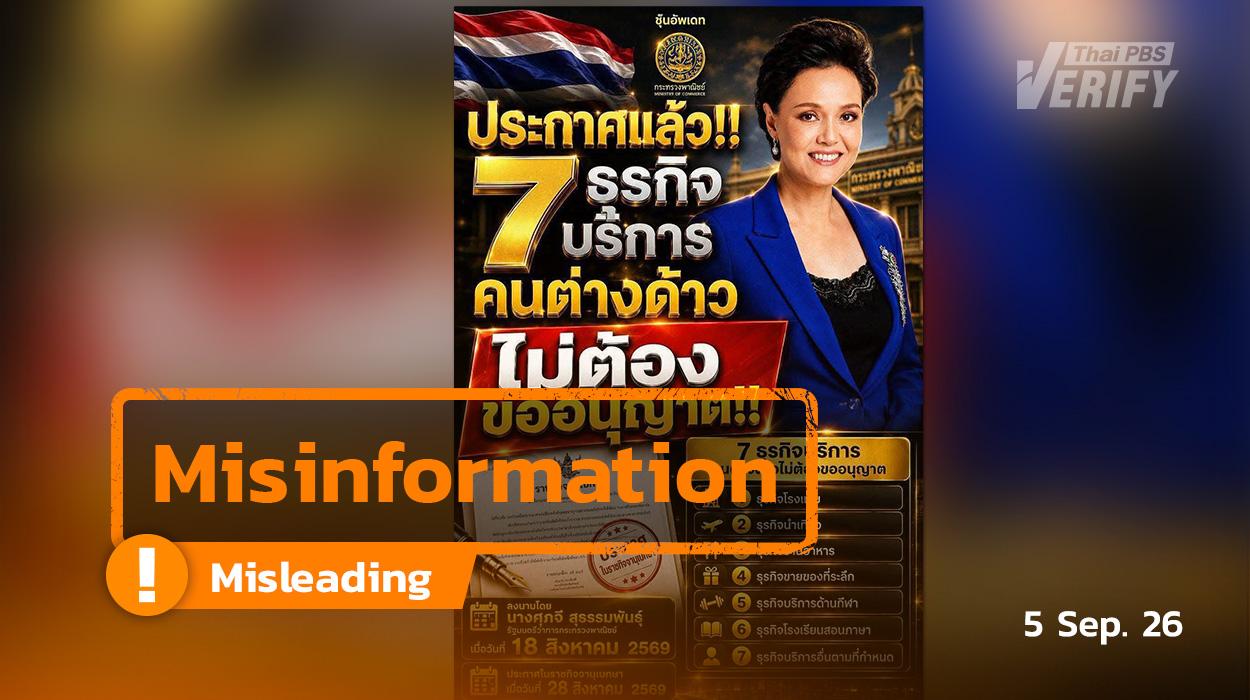
Image of a Facebook account sharing a picture of Suphajee Suthumpun, Minister of Commerce, along with the message “7 service businesses that foreign nationals do not need permission to operate”
Thai PBS Verify found a Facebook account sharing a picture of Suphajee Suthumpun, Minister of Commerce, along with the message, “7 service businesses that foreign nationals do not need permission to operate.”
The caption accompanying the post stated:
“#7ServiceBusinesses
#ForeignNationalsDoNotNeedPermissionToOperateA business!!
Signed by Suphajee Suthumpun, Minister of Commerce, on August 18, 2026.
At the same time, this Ministerial Regulation also adds seven types of service businesses that foreign nationals do not need permission to operate, including:
1. Telecommunications services, etc.
2. Treasury center businesses under the law governing foreign exchange control, etc.
3. Business services covering administrative management, human resources and information technology, etc.
Including cases where a shareholder or partner holds shares or partnership interests amounting to at least 25% of the capital of a juristic person, etc.
4. Services involving the leasing of part of a premises, etc.
5. Services involving guarantees of debts, etc.
6. Services involving the leasing of part of a premises for the installation of electronic machines used to provide financial services, etc.
7. Petroleum drilling services provided by a contractor under a service contract, etc.
The Ministerial Regulation Prescribing Service Businesses That Do Not Require Permission for Foreign Nationals to Operate a Business (No. 5), B.E. 2569 (2026), was issued on August 18, 2026, signed by Suphajee Suthumpun, Minister of Commerce, and published in the Royal Gazette on August 28, 2026.
Source: Thai Post
Isn’t this clearly a “sell-out” law? If such a law is enacted, wouldn’t it make it too easy for foreigners to come and work in Thailand? Doesn’t this effectively give foreigners an opportunity to take away livelihoods from Thai people?
Who came up with this law?
And who is it intended to benefit?
Who stands to gain?”
The post was published on August 31, 2026. It received 81 reactions and 74 comments and was shared more than 62 times.
Do seven service businesses really allow foreign nationals to operate without permission?
What does the graphic claim?
Upon examining the post in detail, Thai PBS Verify found that the main graphic being widely shared stated that seven service businesses do not require foreign nationals to obtain permission to operate. The businesses listed were:
- Hotel businesses
- Tour businesses
- Restaurants
- Souvenir shops
- Sports-related services
- Language schools
- Other service businesses as prescribed by law
What does the caption claim, and why does it contradict the graphic?
However, the caption accompanying the same graphic listed an entirely different set of seven businesses:
- Telecommunications businesses
- Treasury center businesses
- Administrative, human resources and information technology management services provided within affiliated companies
- Services involving the leasing of part of a premises
- Debt guarantee services
- Services involving the leasing of space for the installation of electronic machines used to provide financial services
- Petroleum drilling services
In other words, the graphic and caption in the same post contradict each other. The graphic, which was seen and reshared by most users, does not correspond to the businesses specified in the law.
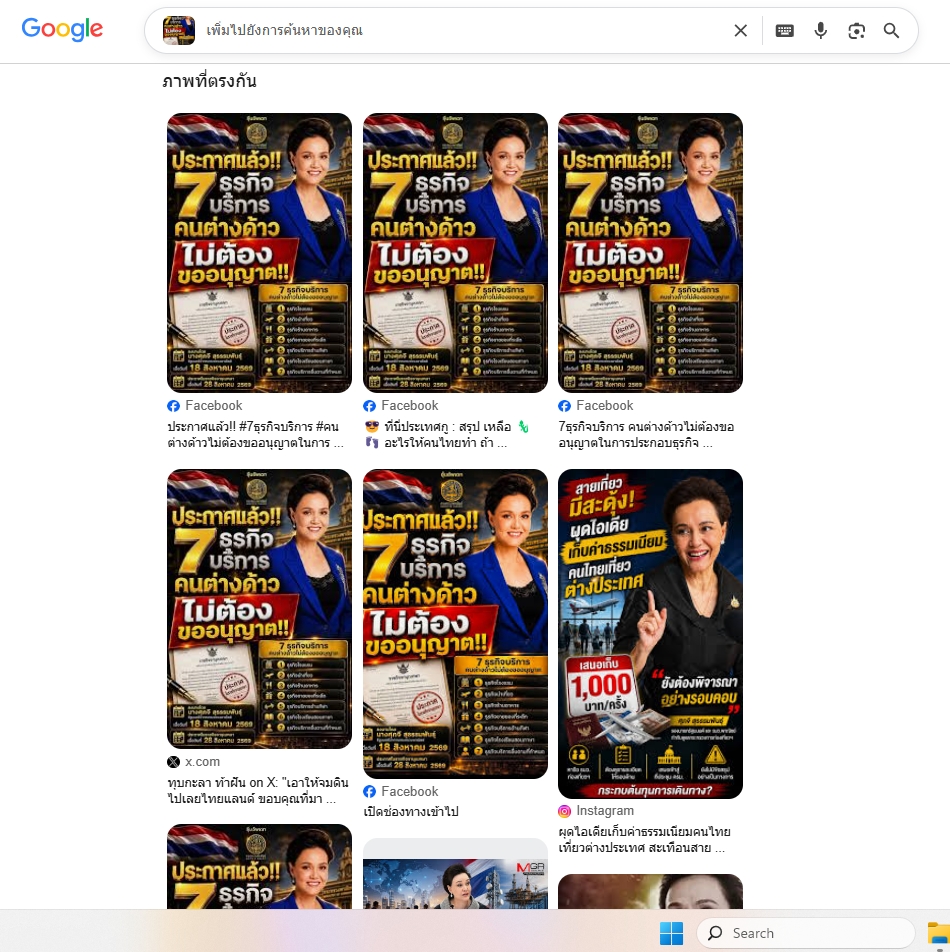
Thai PBS Verify also conducted a reverse image search of the graphic using Google Lens and found that the same graphic had been reposted across numerous accounts and posts.
Checking the Royal Gazette
Thai PBS Verify subsequently examined the claim by searching for the keyword “foreign nationals” on the Royal Gazette website. The search found the Ministerial Regulation Prescribing Service Businesses That Do Not Require Permission for Foreign Nationals to Operate a Business (No. 5), B.E. 2569 (2026).
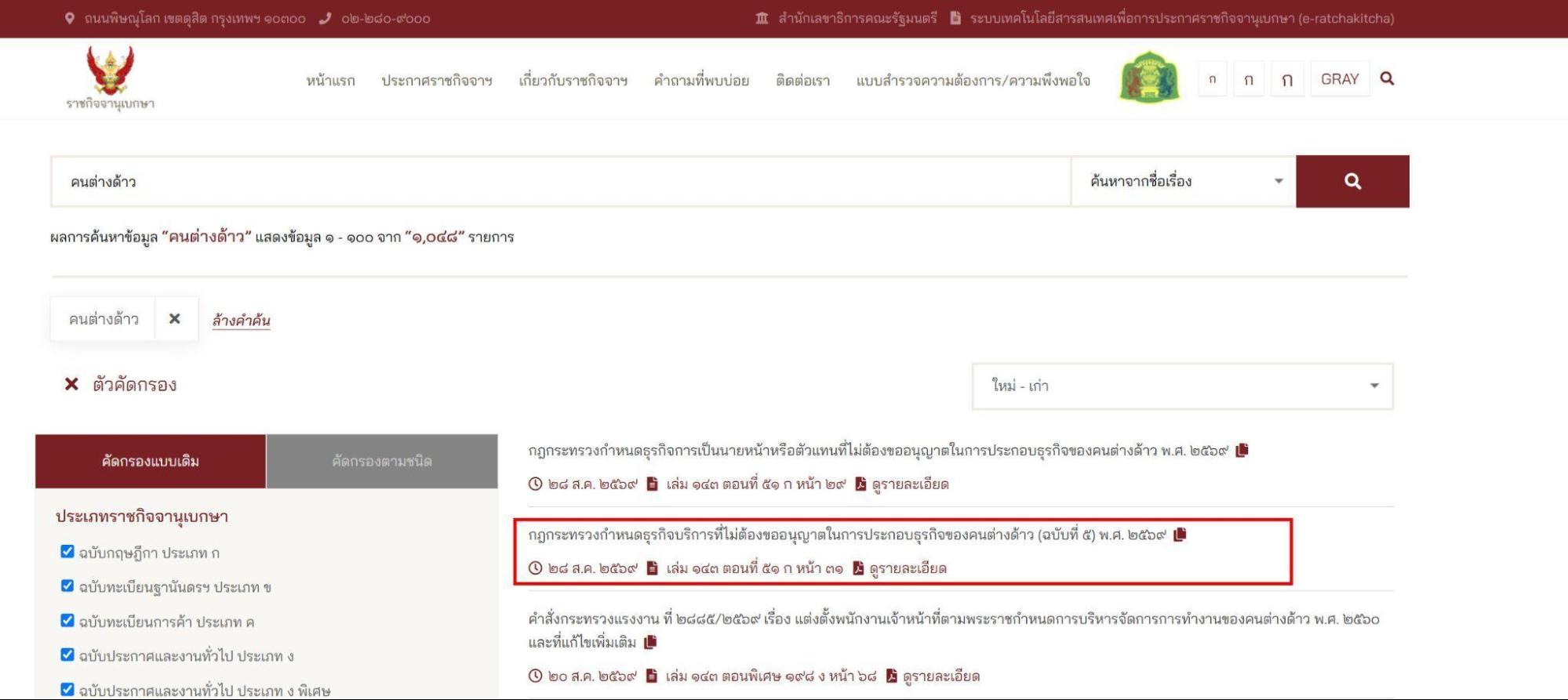
Ministerial Regulation Prescribing Service Businesses That Do Not Require Permission for Foreign Nationals to Operate a Business (No. 5), B.E. 2569 (2026)
The regulation specifies categories of service businesses that foreign nationals can operate without obtaining permission. Key categories exempted under the regulation include:
- Financial, securities and derivatives businesses
This covers lending money for the purchase of securities, securities transactions under repurchase agreements, as well as businesses related to derivatives contracts, including dealers, advisors and fund managers. It also covers treasury center businesses under the law governing foreign exchange control. - Telecommunications businesses
This covers telecommunications businesses holding a Type 1 license, which applies to operators that do not own their own telecommunications networks. - Services between affiliated or related companies
This covers management services such as administrative work, human resources (HR) and information technology (IT), as well as debt guarantee services between related juristic persons, limited to debts arising within Thailand. - Services facilitating employees
This covers the leasing of part of a premises for the installation of electronic machines used to provide financial services, as well as vending machines for goods and services. - Energy-related services
This covers petroleum drilling services provided to concessionaires, production-sharing contractors or service contractors.
The regulation was introduced with the aim of promoting competition and increasing flexibility in business operations by allowing foreign nationals to operate certain types of businesses without having to obtain permission. These are businesses in which Thai operators are considered capable of competing, or services provided for management purposes within affiliated companies or related juristic persons.
However, an examination of the Royal Gazette found no provision identifying the following as seven service businesses that foreign nationals can operate without permission: hotels, tour businesses, restaurants, souvenir shops, sports services, language schools and other prescribed service businesses, as claimed in the post.
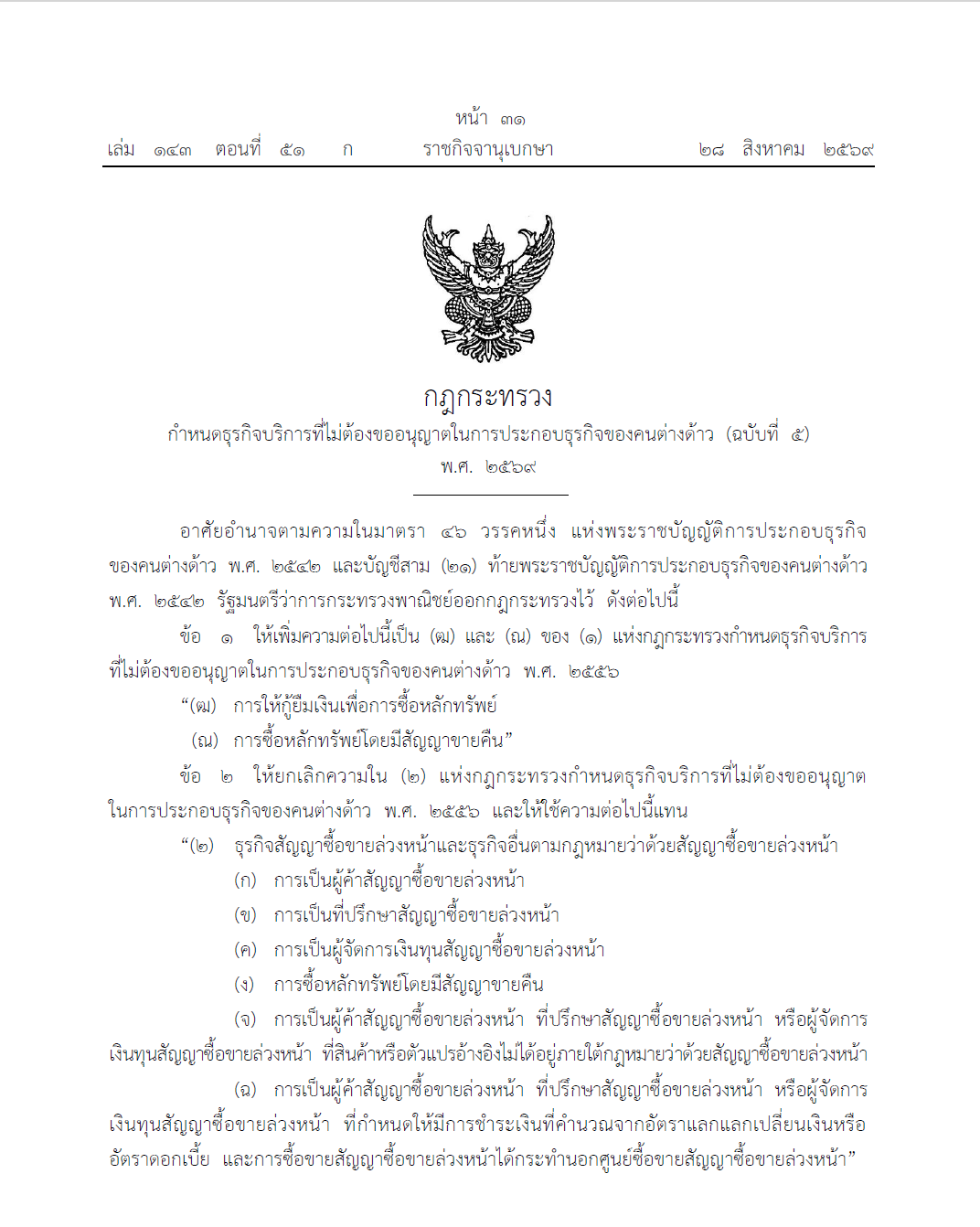
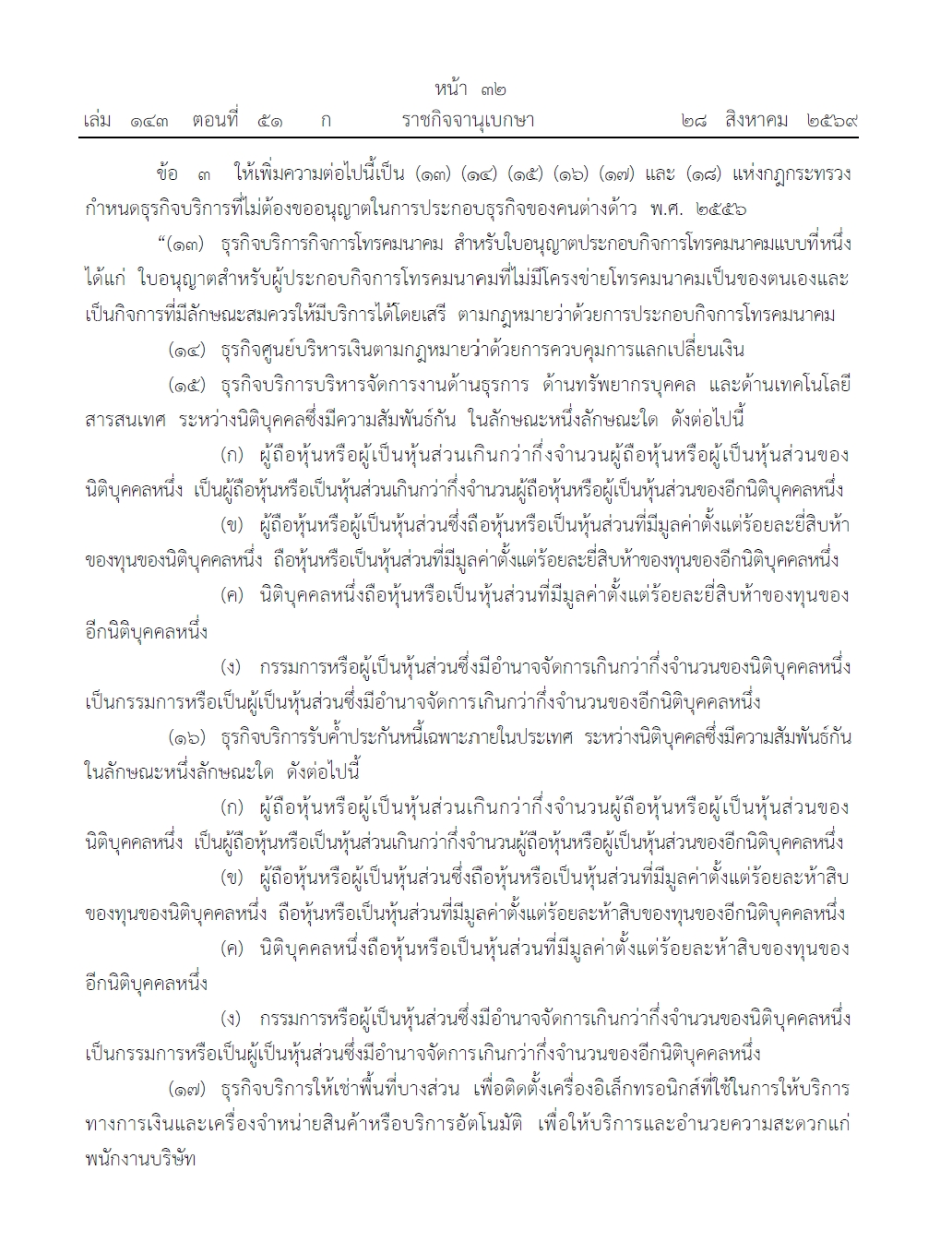
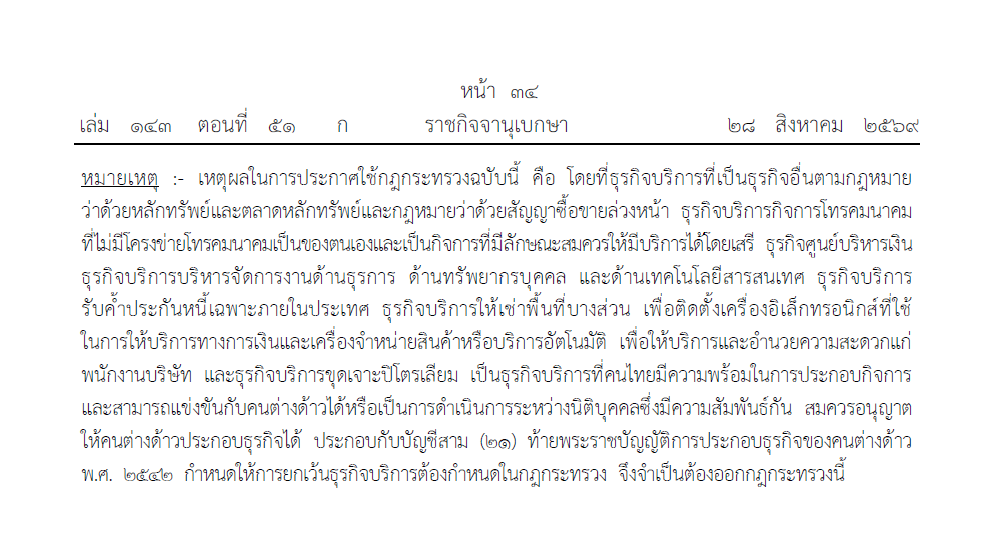
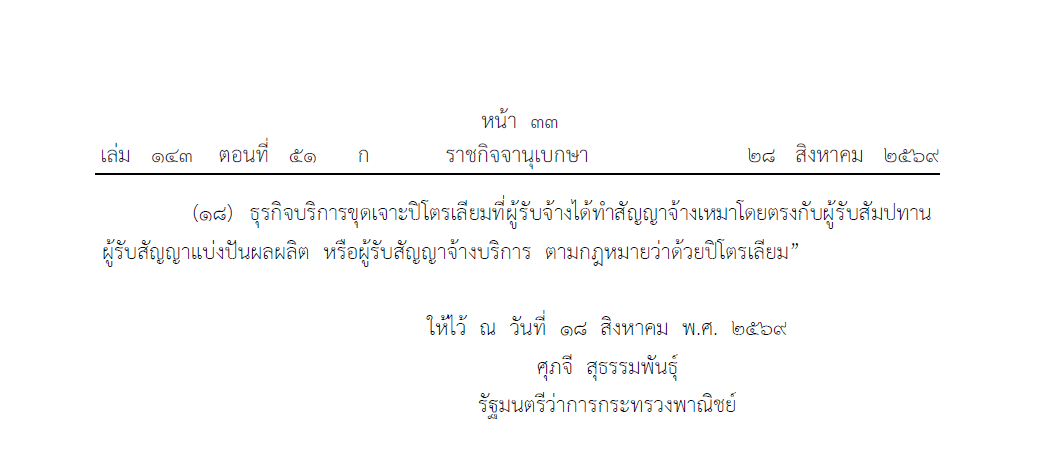
What is the truth?
The Ministerial Regulation Prescribing Service Businesses That Do Not Require Permission for Foreign Nationals to Operate a Business (No. 5), B.E. 2569 (2026) was indeed published in the Royal Gazette on August 28, 2026. It added seven types of service businesses that foreign nationals can operate without obtaining permission.
However, these seven businesses are not hotels, tour businesses, restaurants, souvenir shops, sports services, language schools or other prescribed service businesses, as claimed in the post.
An examination of the regulation found that the seven types of service businesses added under the regulation are subject to specific characteristics and conditions. They include Type 1 licensed telecommunications businesses; treasury center businesses; administrative, human resources and information technology management services between related juristic persons; certain services involving the leasing of space for the installation of electronic machines used to provide financial services and vending machines; debt guarantee services between related juristic persons subject to specified conditions; and petroleum drilling services subject to the conditions prescribed by law.
Therefore, the claim that the Royal Gazette “announced seven additional service businesses” contains an element of truth, as the regulation does establish seven categories of exempted service businesses. However, presenting hotels, tour businesses, restaurants, souvenir shops, sports services, language schools and other prescribed service businesses as the seven businesses that foreign nationals can operate without permission does not correspond to the details of the regulation.
In summary, the seven businesses listed in the caption are broadly consistent with the actual categories of businesses covered by the regulation, but the main graphic that was widely shared contains completely incorrect information. This is a key reason why the post has led to widespread misunderstanding.
The claim is therefore classified as “Misleading”, as it takes some factual information and rearranges and interprets it in a way that creates a misunderstanding.
Verification Process
- Checked the Royal Gazette: Thai PBS Verify examined the claim by searching for the keyword “foreign nationals” on the Royal Gazette website. The actual regulation published in the Royal Gazette exempts specific financial, telecommunications, intra-group service and petroleum drilling businesses, rather than the seven businesses claimed in the graphic.
- Reverse image search using Google Lens: Thai PBS Verify conducted a reverse image search of the main graphic listing the seven businesses—hotels, tour businesses, restaurants and others—using Google Lens. The search found that the same graphic had been reposted across numerous social media accounts and posts, indicating that the graphic had been repeatedly circulated widely rather than being newly produced specifically to accompany this particular news story.
Impact of False Information
- May cause the public to misunderstand the law: The claim may lead people to believe that foreign nationals can freely operate businesses in Thailand without obtaining permission in all cases.
- May create misunderstanding about the rights of foreign nationals: Referring to these as “seven businesses” may lead to misunderstanding about the scope of businesses that are exempt from the legal permission requirement.
- May raise concerns about competition with Thai workers and businesses: The post may create the perception that the law allows foreigners to enter Thailand and compete with or take away business opportunities and livelihoods from Thai people.
- May contribute to negative attitudes toward foreign nationals: The use of strong language, such as “a sell-out law,” may fuel anti-foreigner sentiment or create tension between Thai people and foreign nationals.
- May undermine trust in government agencies and the law: Disseminating incomplete or inaccurate information about the law may cause the public to lose confidence in the legislative process and the work of government agencies.
What to do with this misinformation?
- Read the original source in full: Particularly when dealing with legal information, check the original text and any relevant conditions. Do not rely solely on excerpts or infographics that have been circulated online.
- Do not rush to share if you are unsure: If you encounter information making claims about rights or laws that could be misleading, pause and verify it before sharing.
- Be cautious of language that may promote hate: Separate facts from opinions, and avoid generalizations or language that could fuel hostility toward foreign nationals.
- If you find that information is false, warn others: You can clarify the facts using information from reliable sources and avoid unnecessarily resharing the false information, helping prevent it from spreading further.