Kalmaegi Is Not Heading to Thailand Today Viral post recycles a 2025 TMD announcement
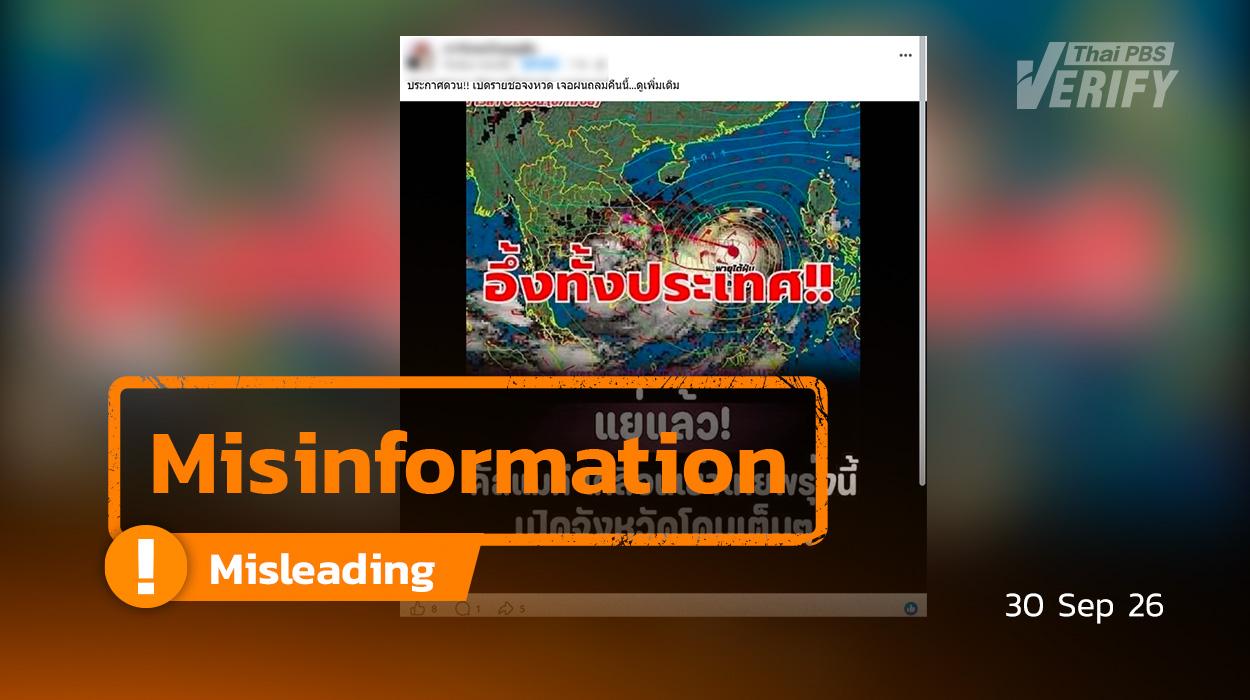
The misleading post originated on Facebook.
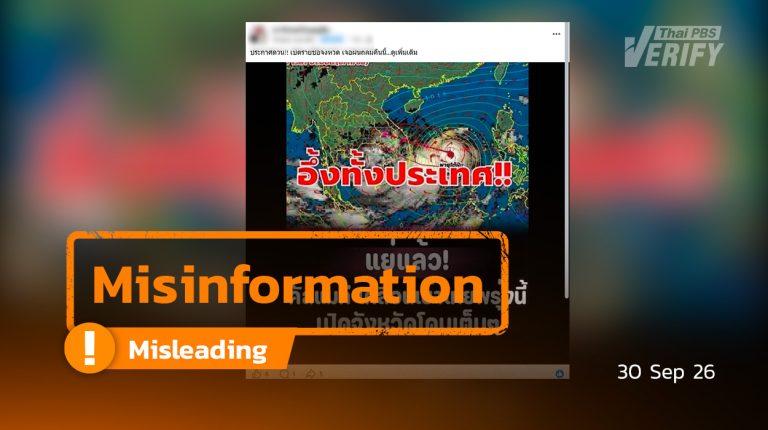
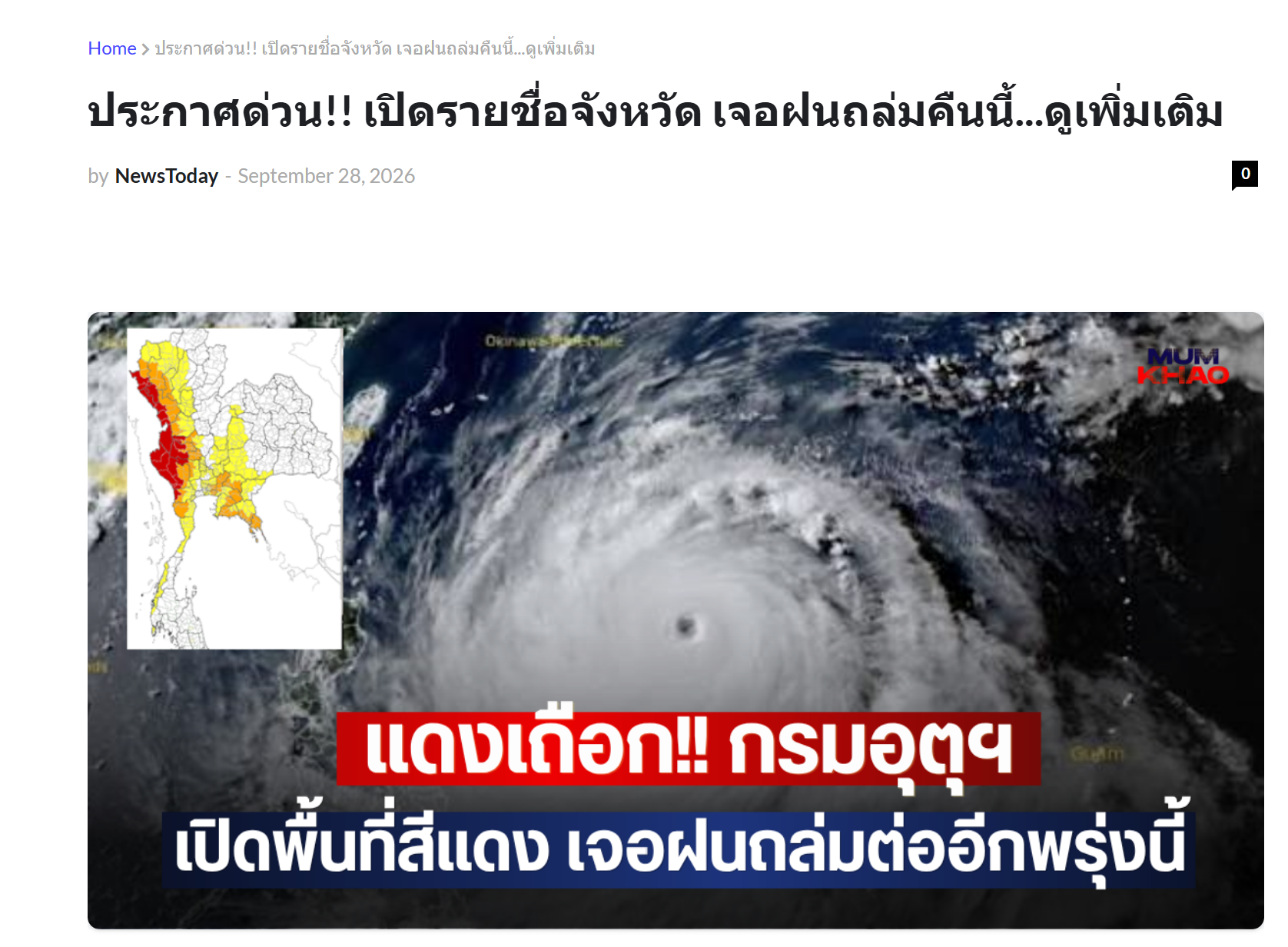
“The whole country is shocked! Oh no! Kalmaegi is moving into Thailand tomorrow—see which provinces will be hit hardest.”
The Facebook post also carried the caption: “Urgent announcement! See the list of provinces facing torrential rain tonight.” It was posted on September 29, 2026.
Is Typhoon “Kalmaegi” Really Entering Thailand?
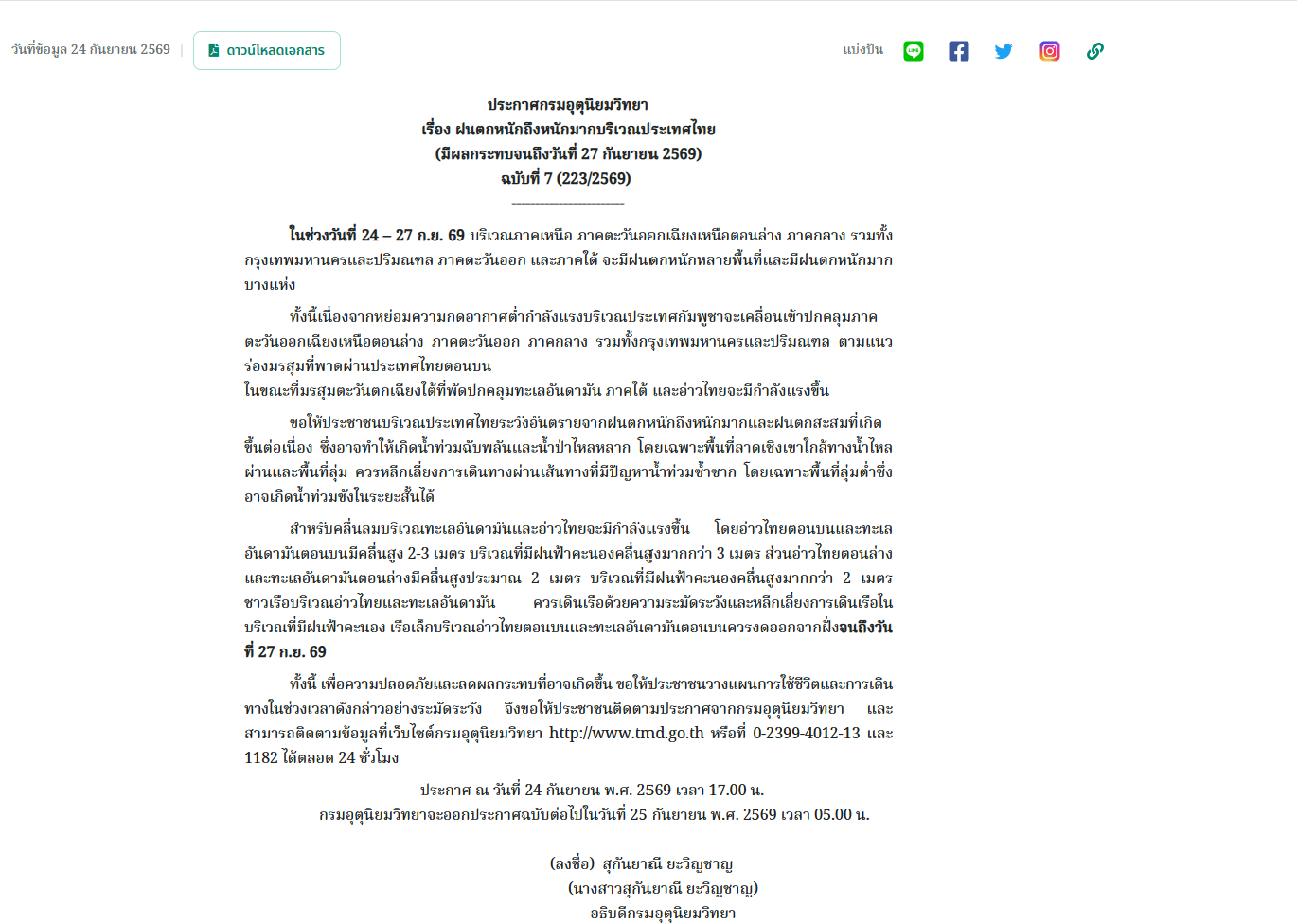
Thai PBS Verify searched the Thai Meteorological Department website using the keyword “heavy rain” (ฝนตกหนัก) and found a TMD announcement titled “Heavy to Very Heavy Rain over Thailand,” which was effective through September 27, 2026. The announcement warned of heavy to very heavy rain in some areas of the North, lower Northeast, Central region, Bangkok and its vicinity, the East, and the South, with risks of flash floods, forest runoff, and localized flooding.
The Andaman Sea and the Gulf of Thailand were experiencing stronger winds and waves, with wave heights of 2–3 meters and waves exceeding 3 meters in areas experiencing thunderstorms. Small vessels were advised to remain ashore in designated areas through September 27, 2026.
Thai PBS Verify พบบัญชีเฟซบุ๊กแชร์ภาพระบุว่า “อึ้งทั้งประเทศ แย่แล้ว! คัลแมกี เคลื่อนเข้าไทยพรุ่งนี้ เปิดจังหวัดโดนเต็ม ๆ “ พร้อมทั้งระบุว่า “ประกาศด่วน!! เปิดรายชื่อจังหวัด เจอฝนถล่มคืนนี้” ถูกโพสต์เมื่อวันที่ 29 ก.ย. 69
Thai PBS Verify also searched the TMD website for “Typhoon Kalmaegi.” The findings were as follows:
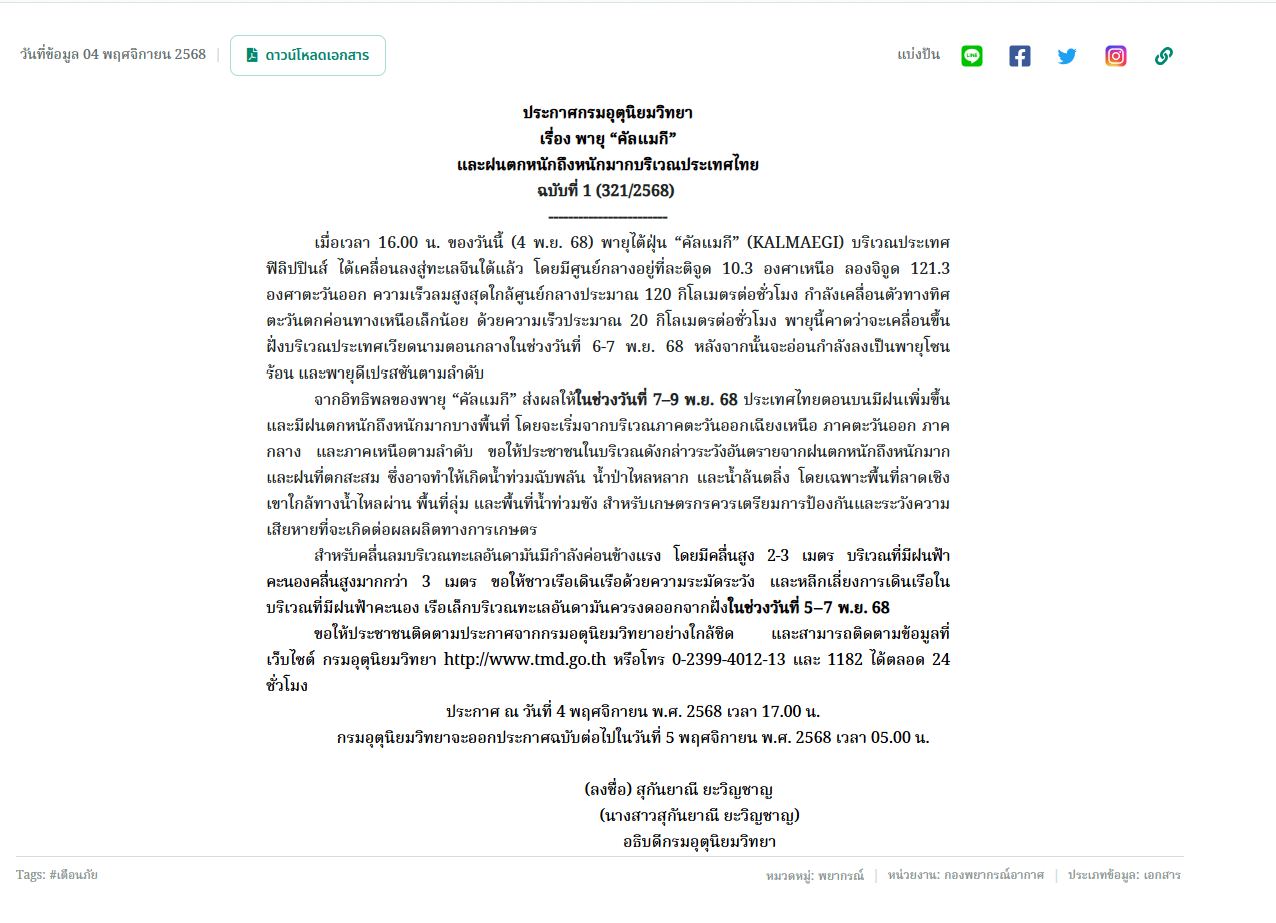
In Warning No. 1 (321/2568), issued by the Thai Meteorological Department, the TMD stated that at 4:00 p.m. on November 4, 2025, Typhoon “KALMAEGI,” then over the Philippines, had moved into the South China Sea. Its center was located at 10.3°N, 121.3°E, with maximum sustained winds of approximately 120 km/h near the center. The typhoon was moving west-northwestward at about 20 km/h.
The TMD forecast that Typhoon “Kalmaegi” would make landfall in central Vietnam between November 6 and 7, 2025, before weakening into a tropical storm and then a tropical depression.
Under the influence of the storm, upper Thailand was expected to receive increased rainfall, including heavy to very heavy rain in some areas, from November 7 to 9, 2025. Rain was expected to begin in the Northeast, followed by the East, Central region, and North, respectively.
The TMD advised residents in affected areas to beware of hazards from heavy to very heavy rain and accumulated rainfall, which could cause flash floods, forest runoff, and overflowing rivers, particularly in hillside areas near waterways, low-lying areas, and places prone to waterlogging. Farmers were also advised to take precautions against potential damage to agricultural produce.
In the Andaman Sea, waves were expected to reach 2–3 meters and could exceed 3 meters in areas experiencing thunderstorms. The TMD advised mariners to exercise caution and avoid sailing in areas affected by thunderstorms. Small vessels in the Andaman Sea were advised to remain ashore from November 5 to 7, 2025.
The link attached to the viral post led to a report dated September 28, 2026, containing the TMD’s 24-hour weather forecast. It stated that the western and lower parts of the North, the western Central region, and the East would continue to experience heavy to very heavy rain in some areas, while rainfall in other regions would decrease, although isolated heavy rain remained possible. This forecast concerned a different issue from the claim made in the viral post.
How Are Storms Named?
Mr. Somkuan Tonjan, Director of the Aeronautical Meteorology Division, explained that storm naming follows agreements established by the Typhoon Committee. Each member country submits 10 names. The Committee then arranges the names in a table according to the prescribed sequence, divided into five columns. The names are drawn from words or names in the local languages of the participating countries. Once the table is established, storm names are assigned sequentially from Column 1 through Column 5 before the cycle begins again.
Storm-name submissions must meet criteria established by the Typhoon Committee. If a proposed name has a meaning or pronunciation that is similar to a name from another country, it may be removed to avoid duplication or confusion. Countries eligible to submit names are those likely to be affected by such storms, while countries in areas where tropical cyclones are unlikely to occur are generally not included, such as Singapore, the Seychelles, Malaysia, and Indonesia.
Once the names have been submitted, the Typhoon Committee jointly reviews and arranges them in the table. When a tropical cyclone forms, the designated regional authority assigns a name. For the Western North Pacific and South China Sea, the Regional Specialized Meteorological Centre (RSMC) Tokyo in Japan is responsible for monitoring the system from the initial low-pressure area through the stages of tropical depression, tropical storm, and typhoon. Once a system develops into a tropical storm, RSMC Tokyo assigns the next name in the sequence approved by the Typhoon Committee. Individual countries cannot name storms arbitrarily; the approved sequence must be followed.
If a storm causes severe damage, a proposal may be made to retire its name from the official list. For example, if a storm named “Mangkhut,” which was proposed by Thailand, caused severe damage in a country through flooding, loss of life, or widespread impacts, the name could be proposed for retirement at a Typhoon Committee meeting. Once a name is retired, the country that originally submitted it has the right to propose a replacement.
For example, if Thailand proposed the name “Mangkhut” and the typhoon later caused severe damage in China and was retired, Thailand could propose a replacement name, such as “Noi-na” or another eligible name. The replacement must not duplicate an existing name or violate the established criteria, and it must be submitted to the Typhoon Committee for consideration before being added to the sequence table.
Storm-name retirement is relatively uncommon because the Typhoon Committee meets once a year to consider various matters, including storm names. Even if a proposed name does not duplicate another country’s name, member countries may request reconsideration if they believe the name has an undesirable meaning or is inappropriate in their country. Ultimately, the names must be mutually agreed upon and arranged in the table for use in sequence as cyclones occur.
The current list of storm names can be checked through Thailand’s official storm-naming information. Once the name of one storm is known, the sequence can be used to determine the name assigned to the next storm.
What Does the Evidence Show?
Thai PBS Verify found that the post’s claim that Typhoon “Kalmaegi” would move into Thailand on September 30, 2026, was false. The information being circulated had been recycled from a Thai Meteorological Department announcement dated November 4, 2025, which referred to a completely different time period from the situation on September 29, 2026.
For the weather situation on September 28–29, 2026, the TMD reported heavy to very heavy rain in some areas of Thailand, particularly parts of the North, Central region, and East. However, the announcement did not state that Typhoon “Kalmaegi” was moving toward or entering Thailand.
Verification Process
- Keyword search: Thai PBS Verify searched the TMD website for “heavy rain” (ฝนตกหนัก). The search found a TMD warning for heavy to very heavy rain in some areas of the North, lower Northeast, Central region, Bangkok and its vicinity, East, and South, with risks of flash floods, forest runoff, and waterlogging through September 27, 2026. Waves in the Andaman Sea and Gulf of Thailand were expected to reach 2–3 meters, exceeding 3 meters in thunderstorms, and small vessels were advised to remain ashore in designated areas.
- Keyword search: Thai PBS Verify searched the TMD website for “Typhoon Kalmaegi” (พายุ คัลแมกี). The TMD announcement dated November 4, 2025 stated that Typhoon “Kalmaegi” had moved across the South China Sea and was expected to make landfall in Vietnam on November 6–7, 2025. Its influence was expected to bring increased rainfall and heavy to very heavy rain to some parts of upper Thailand from November 7–9, 2025, with warnings to residents and mariners about heavy rain, flooding, and rough seas.
Impact of False Information
- It may mislead the public about current weather and storm conditions, causing people to believe that Typhoon “Kalmaegi” is approaching Thailand.
- It may cause unnecessary anxiety or panic, particularly among people living in provinces identified in the misleading post.
- It may cause confusion between historical weather forecasts and current conditions, leading people to follow outdated information.
- It may result in inaccurate assessments of rainfall and local risks and cause people to prepare for conditions that do not reflect the actual situation.
- Sharing information that does not correspond with official warnings may cause confusion when the public follows legitimate disaster alerts from relevant authorities.
What to do with this misinformation?
- Check the date of the announcement to determine whether the information is current or outdated.
- Verify storm and weather information directly with the Thai Meteorological Department or other relevant authorities.
- Cross-check the information against official announcements or reports from verified sources.
- If information is found to be outdated or misleading, do not share or forward it.
- When warning others, clearly identify the date and source of the information to prevent misunderstanding.