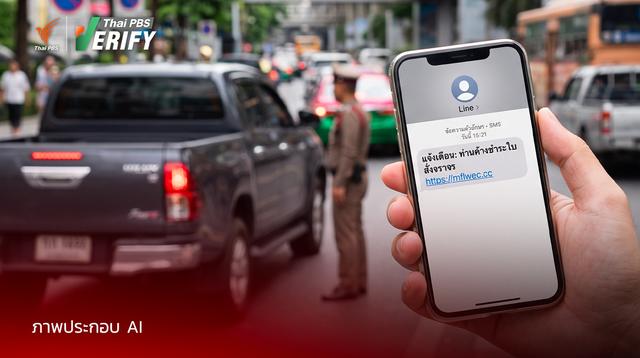
The government denies plans to cancel the New Year festival, dismissing rumors regarding the spread of the Deltacron XBC COVID-19 variant.
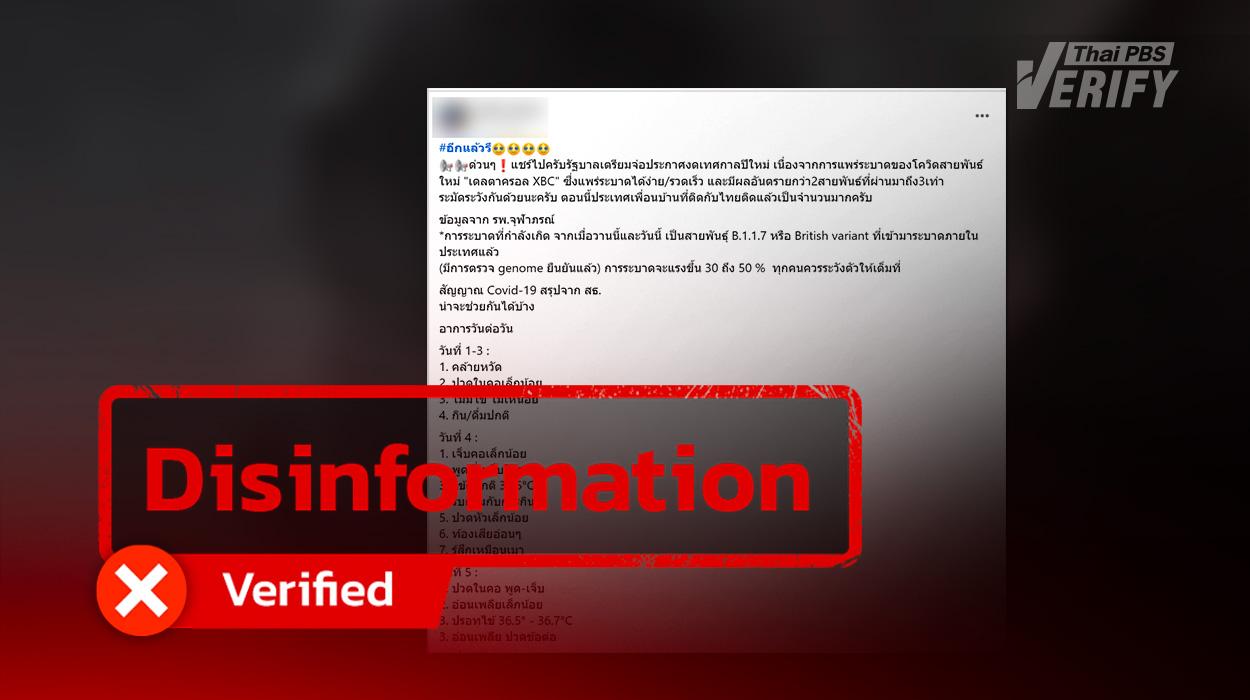
Thai PBS Verify investigated fake news that has been traced back to Facebook.
Thai PBS Verify found a Facebook account sharing a post stating that
“Urgent: Please share. Rumors claim the government will cancel New Year events due to a new ‘Deltacron XBC’ COVID variant that is three times more dangerous and spreads rapidly. It warns that neighboring countries are seeing many cases. Source cited: Chulabhorn Hospital.”
Context: The post originally went up on August 29, 2026, and managed to rack up 168 reactions along with 74 shares.
Is the government planning to cancel the New Year festival?
A keyword search for “government announces New Year festival cancellation” revealed that on August 31, 2026, Deputy Government Spokesperson Ms. Ploy-talay Laksameesaengchan clarified a circulating online rumor. The fake posts—falsely claiming to originate from Chulabhorn Hospital and the Ministry of Public Health—asserted that authorities were set to ban New Year festivities because of a “Deltacron XBC” COVID-19 variant said to be three times deadlier than past strains.
Official Clarification: The government has confirmed that the information is “fake news” which originally circulated in 2022 and has now been recirculated and distorted to cause public panic. There are no orders or measures to cancel any activities or festivals as claimed.
DDC Monitoring Report: Data from the Department of Disease Control indicates that the current COVID-19 trends align with seasonal respiratory illness projections. Furthermore, the country’s healthcare system maintains a sufficient supply of medications and medical equipment to handle patient care effectively.
Genomic Surveillance: Working with the Department of Medical Sciences, officials confirmed that Thailand’s main monitored variant is Omicron (NB.1.8.1), not “Deltacron XBC” as falsely alleged.
Epidemiological Data: According to epidemiological data, the NB.1.8.1 strain does not cause increased severity, with a case fatality rate of approximately 0.01%. Most patients experience symptoms similar to a common cold, while severe cases remain primarily confined to the vulnerable “608” high-risk group.
The Department of Disease Control clarified that there was no proposal to cancel the New Year festival
Thai PBS Verify Update: While the Department of Disease Control clarified that there was no proposal to cancel the New Year festival, Thai PBS Verify later discovered that the department itself had shared a post confirming that claims of the government canceling the New Year celebrations due to the monitoring of all COVID-19 variants were completely false.
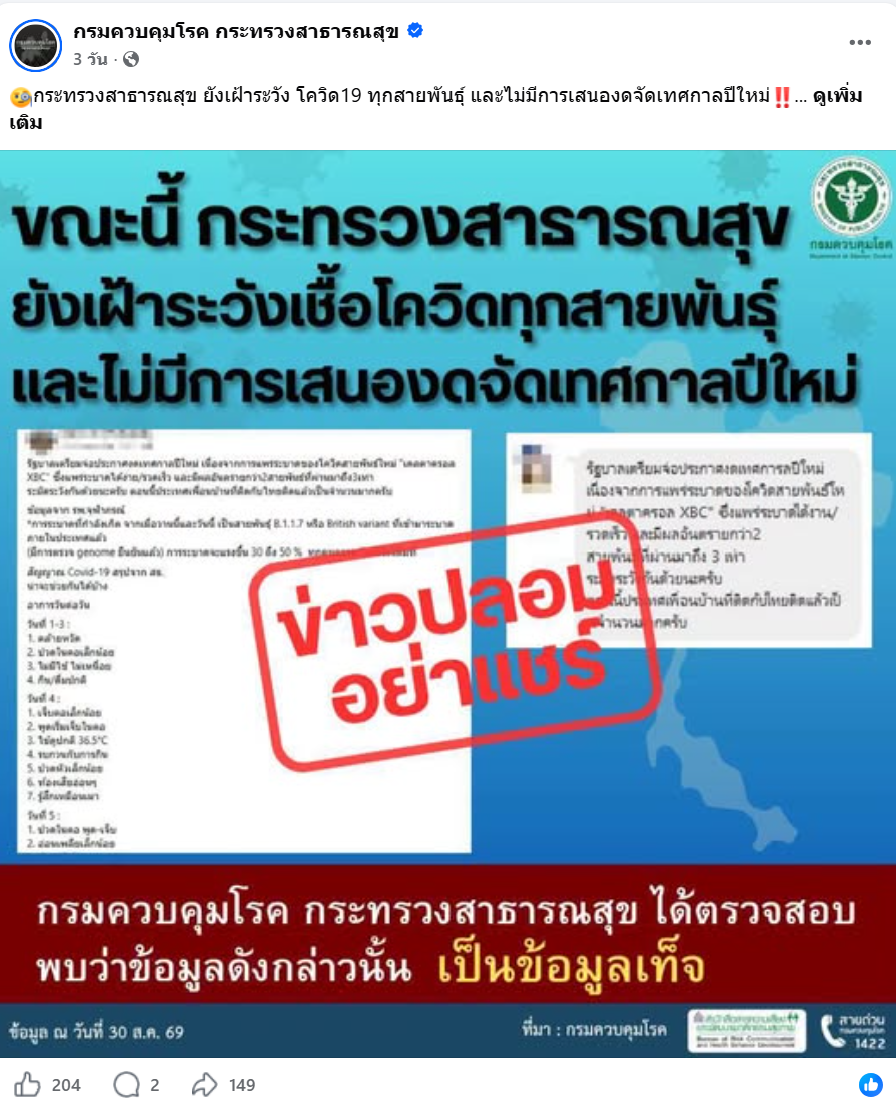
Thai PBS Verify Investigation: We reached out directly to the Department of Disease Control, and they cleared things up for us: neither the department nor the Ministry of Public Health has ever proposed canceling the New Year festival. Those claims floating around are completely fake.

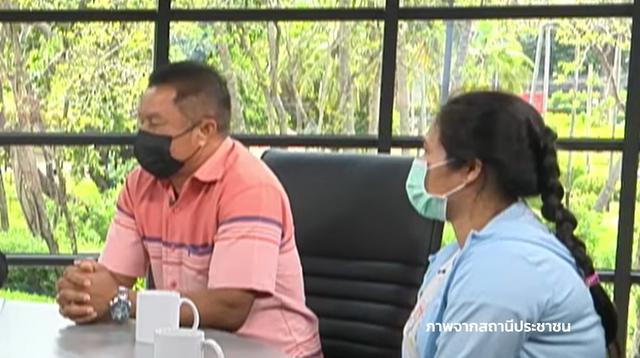
Dr. Montien Kanasawat, Director-General of the Department of Disease Control
Dr. Montien Kanasawat, Director-General of the Department of Disease Control, reported that data from the Digital Disease Surveillance (DDS) system under the Division of Epidemiology—spanning from January 1 through August 28, 2026—shows 95,357 cumulative COVID-19 cases in Thailand (representing an incidence rate of 144.76 per 100,000 population) along with 14 fatalities (a mortality rate of 0.02 per 100,000 population). This results in a case fatality rate of 0.01%, noting that reported cases have trended upward over the past month.
Additionally, other respiratory illness patients, such as those with influenza and respiratory syncytial virus (RSV) infections, are also showing an upward trend.
According to Department of Medical Sciences Omicron surveillance data via GISAID, a cumulative total of 978 cases were monitored from January 1, 2025, to July 23, 2026.
The distribution of dominant strains identified in Thailand shows:
- NB.1.8.1* totaling 490 cases, or 50.10%
- JN.1* totaling 246 cases, or 25.15%
- XEC* totaling 82 cases, or 8.38%
- XFG* totaling 76 cases, or 7.77%
- BA.3.2* totaling 8 cases, or 0.82%
Looking at the most recent variant trends—based on 48 cases tracked between June 19 and July 20, 2026—NB.1.8.1* is still leading the pack as the main strain, showing up in 27 of those cases (56.25%).
Followed by JN.1* (15 cases, 31.25%), XFG* and BA.3.2* (2 cases each, 4.17%), and others (1 case, 2.08%).
Due to current weather fluctuations and the peak season for respiratory illnesses, we anticipate a rise in patient numbers and potential cluster infections in schools, offices, and local communities. We urge citizens to monitor their health closely. Anyone showing respiratory symptoms—such as fever, cough, sore throat, runny nose, headaches, or exhaustion—should stay home to rest and limit contact with others to protect their families, coworkers, and communities. Self-care during illness is straightforward: if you test positive for an infection, isolate, rest, and avoid going to work or crowded events to prevent spreading the virus. Should you need to go out, please wear a face mask, particularly around vulnerable groups such as the elderly, individuals with chronic health conditions, or the immunocompromised, who face a significantly higher risk of severe complications,” said Dr. Montien.

Dr. Direk Khampan, who serves as the Deputy Director-General of the Department of Disease Control
Dr. Direk Khampan, Deputy Director-General of the Department of Disease Control, also added a practical piece of advice for anyone starting to feel sick: stick to the rule of “resting up and keeping your distance.” That means getting plenty of sleep, avoiding close contact or sharing personal things with others, wearing a mask when you have to be around people, washing your hands often, and keeping your space well-aired. And if you need to head out to see a doctor, make sure to keep your mask on the whole way there.
People with mild symptoms can care for themselves and monitor their condition. Seek immediate medical help if severe symptoms occur, such as breathing difficulties, chest pain, extreme fatigue, or trouble eating and drinking. Older adults, chronically ill patients, and immunocompromised individuals should consult a doctor right away if they get sick to receive proper care.
What is the actual truth?
Contrary to what’s being shared on Facebook, the government is definitely not canceling the New Year festival because of any “Deltacron XBC” COVID-19 variant. Officials have stepped in to confirm that this is completely fake news—just an old rumor from back in 2022 that’s been dug up and shared all over again.
Data from the Department of Disease Control indicates that the COVID-19 situation in Thailand has seen an increase in patient numbers over the past month, which aligns with the seasonal trend of respiratory illnesses. However, there are still no orders or measures to cancel any festivals or events, and the public health system remains fully prepared to handle patients.
Regarding the strains detected through surveillance in Thailand, the primary variant is Omicron NB.1.8.1, not “Deltacron XBC.” Furthermore, data provided by the Department of Disease Control indicates that there is no evidence showing NB.1.8.1 causes increased severity, with a case fatality rate of approximately 0.01%.
From Jan 1 to Aug 28, 2026, Thailand had 95,357 cumulative COVID-19 cases and 14 deaths. The Department of Disease Control advises those with respiratory symptoms to follow the “Stay home, limit contact” rule to stop the spread, especially around the elderly, chronically ill, and immunocompromised individuals.
Verification Process
- XBC is fake news, and no activities have been cancelled.Verification: Thai PBS Verify checked official sources and reported that on August 31, 2026, the government confirmed rumors of a New Year festival ban due to Deltacron XBC are fake, clarifying that no events have been canceled.
- Agency Interview Verification: Information gathered from the Department of Disease Control outlines the current COVID-19 situation and respiratory disease trends, while advising the public to adhere to the “Stay Home, Limit Contact” principle. Citizens are encouraged to wear face masks when necessary and closely monitor severe symptoms, particularly among the vulnerable “608” high-risk group.
The Impact of This Misinformation
- Impact Analysis – Panic Generation: Asserting that a novel COVID-19 strain is exceptionally dangerous and fast-spreading risks triggering unnecessary public panic and anxiety that do not reflect the true epidemiological situation.
- Misrepresenting Government Measures: Claims that the government is preparing to cancel the New Year festival may lead the public to believe that official disease control orders or measures have been enacted when no such announcements have actually been made.
- Harming Trust in Authorities: Dropping the names of hospitals or government agencies without any legitimate source backing it up only ends up confusing people and making them second-guess official information.
- Distorting Health Risk Assessment: Claims that the variant is three times more severe than previous strains may cause the public to overestimate or underestimate the actual situation.
- Amplifying the Spread of Misinformation: Posts utilizing urgent keywords such as “breaking” or “urgent” alongside calls to “share” can prompt readers to forward the information without prior fact-checking.
What to do with this misinformation?
- Do Not Believe or Reshare Prematurely: Exercise caution, particularly with content designed to provoke fear or pressure readers into rapid dissemination.
- Verify Sources: Check information against official government, Ministry of Public Health, or Department of Disease Control websites and channels.
- Check the Date of Information: Because old news articles or messages may be reshared and mistakenly perceived as current events.
- Don’t Trust Names Alone: Mentioning a hospital or government agency doesn’t mean the information is true.
- Cease Sharing Upon Identifying Misinformation: If content is found to be false, transmission should be halted. When necessary, individuals who received the information should be alerted to its inaccuracy to prevent further dissemination.