Viral post claims BMA canceled Grey, Light Blue, and Silver Line monorail projects; in truth, operations were transferred to the Ministry of Transport under an NCTC resolution.
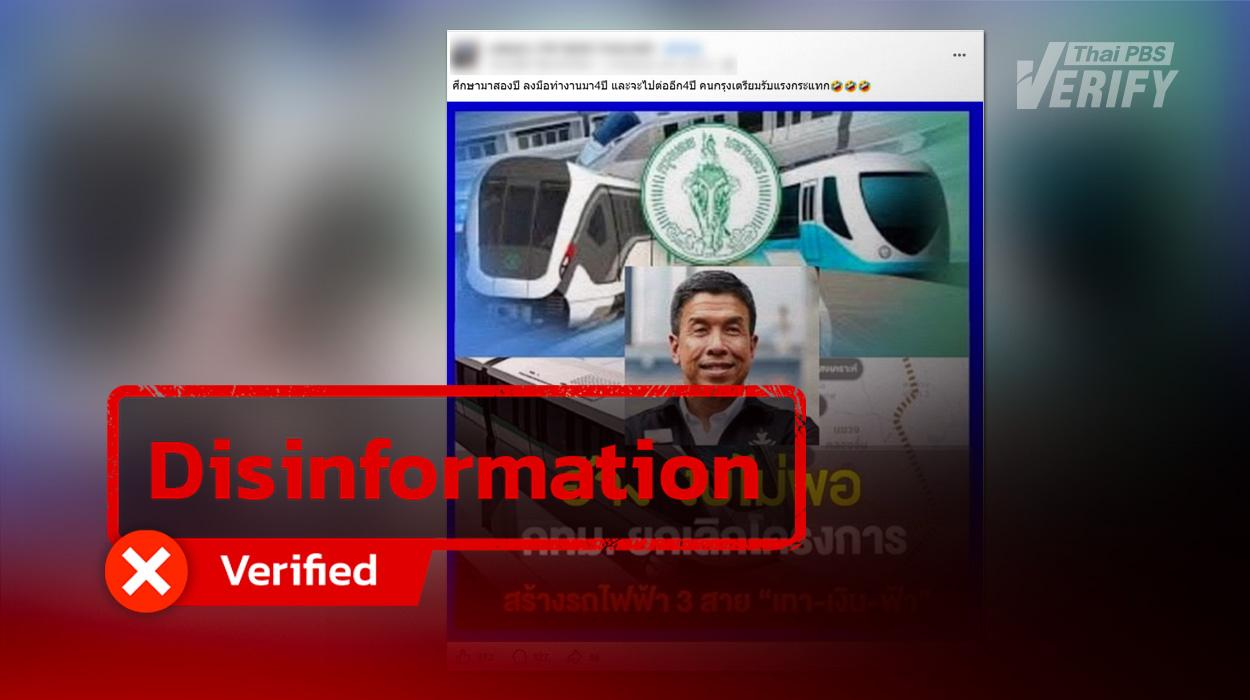
Thai PBS Verify identified the source of the fake news on Facebook
According to Thai PBS Verify, a Facebook account posted images featuring Bangkok Governor Chadchart and an electric train, with text claiming the BMA scrapped three monorail lines (Grey, Light Blue, and Silver) citing insufficient funds. The caption read, ‘Studied for two years, worked for four, and planning for four more years—Bangkok residents, brace yourselves for the impact! 🤣🤣🤣‘
The post received 372 reactions and 127 comments, and was shared more than 36 times.
The inception of the Silver, Grey, and Light Blue MRT line projects
Initiated under the M-MAP 1 master plan created by the OTP in 2010, the Light Blue, Silver, and Grey lines were developed at different stages as part of a broader roadmap for Bangkok’s future mass transit network.
Specifically, the Grey and Silver Lines were planned as secondary feeder systems, aimed at linking neighborhoods and supplying commuters to the main transit lines. Meanwhile, the Light Blue Line was envisioned to drive urban renewal in Din Daeng and promote commercial development around Makkasan Central Station, guided by Transit-Oriented Development (TOD) concepts.
Between 2015 and 2019, the Bangkok Metropolitan Administration (BMA) actively pushed the Grey and Silver Line projects forward by allocating funds to hire consulting firms. These consultants were tasked with conducting feasibility studies, designing route alignments, detailing station specs, and preparing Environmental Impact Assessment (EIA) reports, as well as holding multiple public hearings. The BMA originally aimed to invest in and construct the lines itself to expand its transit network beyond the Green Line into broader areas.
Are the BMA’s Silver, Grey, and Light Blue Lines Really Canceled?
Thai PBS Verify reached out to the Bangkok Metropolitan Administration (BMA) Public Relations Department for clarification. Officials reported that on February 12, 2024, Deputy Governor Wisanu Subsompon chaired the 1/2024 Executive Committee Meeting for the BMA Mass Transit System Project at Bangkok City Hall. The meeting was attended by BMA executives, as well as representatives from the Traffic and Transportation Department, the Department of Public Works, and related agencies.
The meeting reviewed guidelines for transferring responsibility for new transit line investments from the Bangkok Metropolitan Administration (BMA) back to the Ministry of Transport. These projects include the Silver Line (Bang Na–Suvarnabhumi Airport), the Grey Line Phase 1 (Vatcharaphol–Thong Lo), and the Light Blue Line (Din Daeng–Sathon).
According to the BMA, reassigning these line developments to the Ministry of Transport will improve project management efficiency and best serve commuters, allowing full integration with existing and planned MRTA rail routes.
Additionally, the routes of the Grey and Silver Lines connect directly with regions and rail networks supervised by the Ministry of Transport. This integration facilitates comprehensive mass transit management, including the implementation of a common ticketing system, entry fee structures, and government fare initiatives such as the 20-baht flat-rate fare policy.
Additionally, the meeting affirmed that the Ministry of Transport has strong investment capacity for megaprojects, along with readiness in funding procurement, operational support, and fare policy subsidies to keep project progress structured and efficient.
Moving forward, the secretariat will present the proposal to BMA executives for approval regarding the transfer of the three MRT line projects, before proceeding with the next steps.
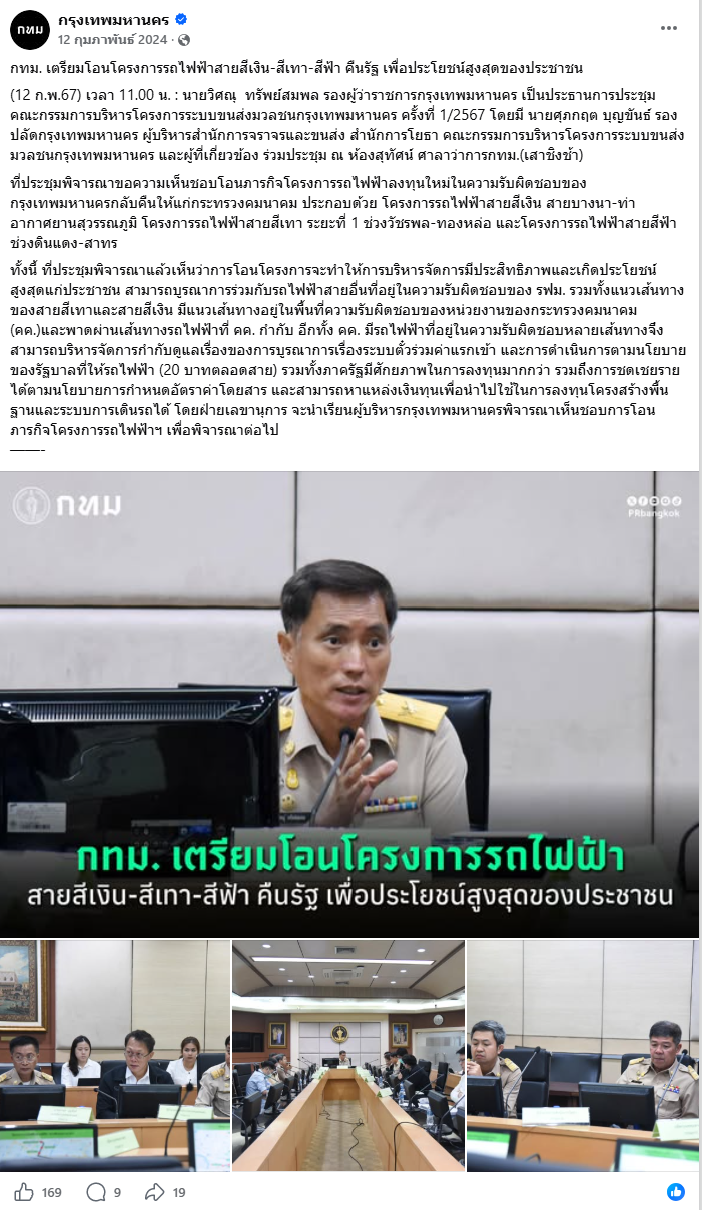
The official Bangkok Metropolitan Administration Facebook page reported on the BMA Mass Transit System Project Executive Committee Meeting No. 1/2024.
On the Ministry of Transport’s side, the Commission for the Management of Land Traffic (CMLT) held its first meeting of 2024 on December 23, 2024, presided over by then-Deputy Prime Minister and Transport Minister Suriya Juangroongruangkit. The meeting addressed three major agenda items: first, returning the responsibility for three BMA-managed rail projects to the Ministry of Transport, covering the Silver, Grey Phase 1, and Light Blue Lines; second, rerouting the Red Line suburban train to connect Wongwian Yai to Mahachai instead of Hua Lamphong to Mahachai; and third, launching the R-Map feasibility study to build a comprehensive, seamless rail network connecting all regions nationwide with multimodal transit link
The Office of Transport and Traffic Policy and Planning (OTP) held the first 2024 meeting of the Commission for the Management of Land Traffic (CMLT).
MRTA Moves Ahead with Hiring Consultants for Grey and Silver Line Studies
According to the MRTA, as quoted by Thai PBS Verify, the Light Blue, Silver, and Grey Line projects have been reassigned from the BMA to the MRTA, following a December 2024 CMLT resolution.
Currently, consultant selection is underway to review feasibility and plans for the Grey and Silver Lines. Meanwhile, the MRTA is preparing to undertake feasibility studies, project designs, tender documents, EIA reports, and PPP studies for the Light Blue Line.
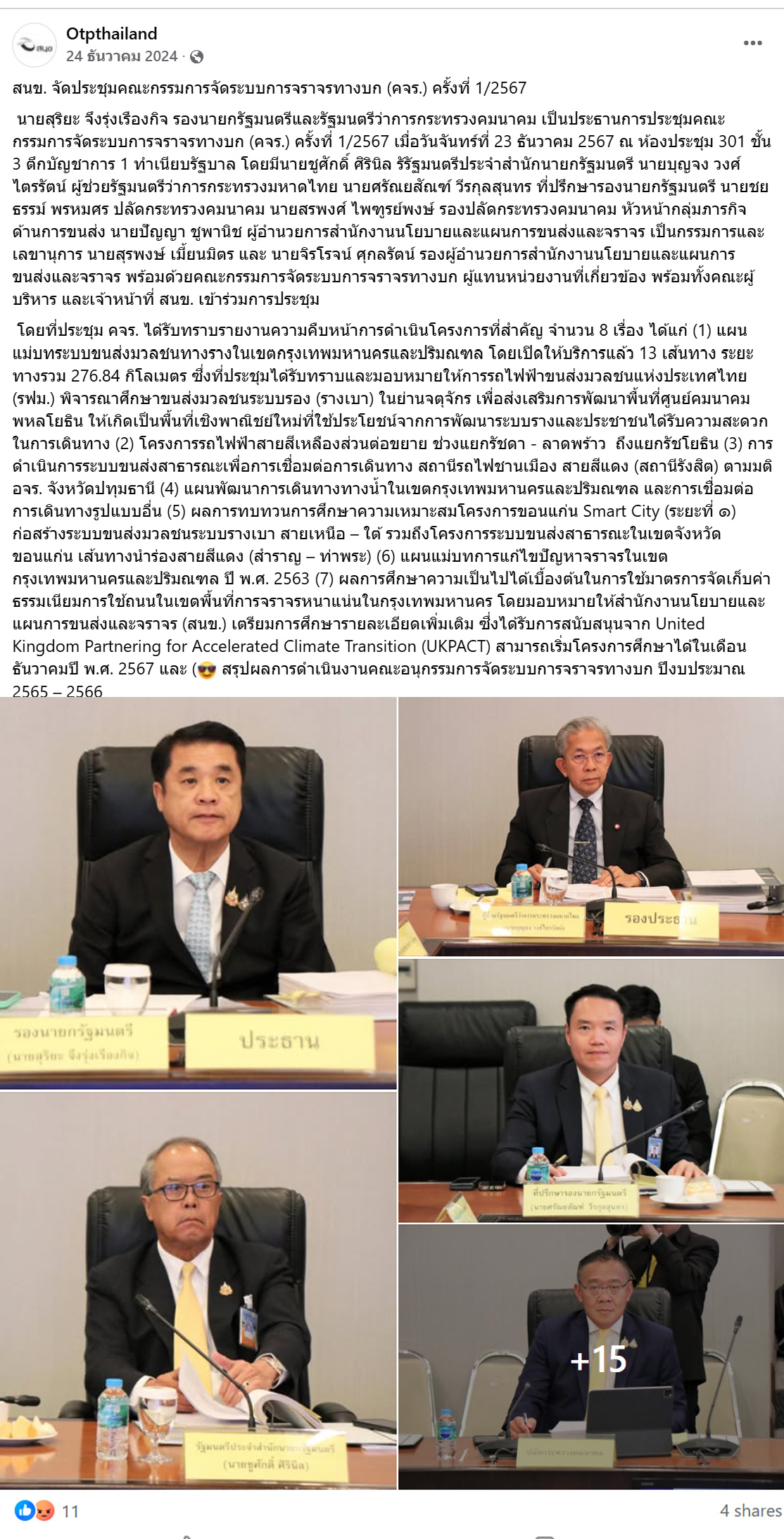
The Office of Transport and Traffic Policy and Planning (OTP) held the first 2024 meeting of the Commission for the Management of Land Traffic (CMLT).
What is the actual truth?
Claims circulating on social media that the BMA canceled the Grey, Silver, and Light Blue Line projects are untrue. Rather than scrapping the plans, the BMA has handed over responsibility to the Ministry of Transport to ensure a more integrated and efficient rail network. The Ministry is better equipped to manage these projects given its financial resources for major infrastructure investments and its capacity to seamlessly align them with other rail lines.
Subsequently, at the policy level, the Commission for the Management of Land Traffic (CMLT) passed a resolution on December 23, 2024, officially approving the transfer of all three MRT lines—Silver (Bang Na–Suvarnabhumi), Grey (Vatcharaphol–Thong Lo), and Light Blue (Din Daeng–Sathon)—from the BMA to the Ministry of Transport. The projects remain actively under development.
The Mass Rapid Transit Authority of Thailand (MRTA) is serving as the primary operating agency, currently preparing to hire consultants to review project feasibility for the Grey and Silver Lines. For the Light Blue Line, it is undertaking feasibility studies, project design, Environmental Impact Assessments, and Public-Private Partnership (PPP) model formulations. Therefore, these three MRT line projects have not been canceled; rather, they are moving forward under a new governing authority to deliver maximum long-term benefits to the public.
Why has this post resurfaced recently?
Several factors contribute to this misconception: the term ‘project transfer’ is often misconstrued as ‘cancellation,’ while the lack of physical construction makes the ongoing study phase seem static. Coupled with political views on BMA leadership, these points triggered sarcastic captions about ‘insufficient budget’ or ‘bracing for impact,’ driving the spread of distorted information across social media.
However, according to official data, the Grey, Silver, and Light Blue Line MRT projects remain active under the responsibility of the Ministry of Transport. The Mass Rapid Transit Authority of Thailand (MRTA) is currently conducting feasibility studies, reviewing project details, designing routes, and preparing Environmental Impact Assessment (EIA) reports as well as Public-Private Partnership (PPP) models. Therefore, claims stating the projects have been ‘canceled’ are incorrect; it is simply a transfer of lead authority to enable the projects to move forward more efficiently in the long run.
Verification Process
- Cross-checking News Sources: Thai PBS Verify reached out to the BMA Public Relations Office, confirming that responsibility for the Silver, Grey, and Light Blue Line projects has been handed over to the Ministry of Transport. The transition is designed to improve overall rail integration, streamline common ticketing, and align with the 20-baht flat-rate fare policy.
- Keyword Search Verification: The CMLT meeting on December 23, 2024, approved the transfer of the Silver, Grey, and Light Blue Line projects from the BMA back to the Ministry of Transport, alongside route adjustments for the Red Line suburban train (Wongwian Yai–Mahachai) and the advancement of the nationwide rail network development study (R-Map).
- Source Interview: The MRTA informed Thai PBS Verify that it officially received the Light Blue, Silver, and Grey Line developments from the BMA following the December 2024 CMLT decision. The Silver and Grey Lines are entering consultant procurement for project review, while the Light Blue Line remains in feasibility, design, and EIA/PPP formulation phases.
The Impact of This Misinformation
- Widespread Misinformation: It misled the public into thinking the developments were ‘canceled’ rather than ‘reassigned.’ This resulted in a distorted view of public policy and city development goals.
- Undermining Trust in Government Agencies: Such news can lead the public to view state administration as failing or lacking budget, when in fact that is not the case. This aligns with academic studies indicating that ‘fake news’ significantly erodes trust in public institutions.
- Fueling Criticism and Social Conflict: Distorted content spreads rapidly on social media, sparking heated debates, online drama, and politically motivated attacks—all built upon incomplete information. Over time, these disputes can escalate into broader societal conflict.
- Influencing Citizens’ Decision-Making: Misleading information distorts public understanding of policies, directly affecting how people make choices—whether during elections or when assessing the performance of local government leaders.
- Distorting the Big Picture of Infrastructure Development: It can lead the public to believe that rail projects have ground to a halt, when in reality they remain in active study and development. This ultimately impacts economic confidence and long-term investment.
- Heightening the Risk of Political Exploitation and Sensationalism: Fake news is frequently weaponized to manipulate public opinion or stir discontent against specific factions. This is a classic hallmark of ‘Information Disorder,’ which deepens societal confusion and drives political polarization.
What to do with this misinformation?
- Pause before believing or sharing: Be cautious of sensational headlines or provocative language like ‘instant cancellation’ or ‘running out of funds.’ These emotional triggers are frequently deployed to attract attention and amplify misleading information
- Verify the source: Check whether the post originates from an official agency, mainstream media, or an anonymous page. Extra caution is warranted if the information does not come from a reliable source.
- Cross-check with multiple sources: Verify claims against reports from relevant agencies, like the BMA or the Ministry of Transport, to ensure consistency.
- Read beyond the headline: Headlines are often written to mislead, while the actual article content may not state that the project was ‘canceled’ as claimed.
- Spot irregularities: Identify mismatched visuals, outdated content repurposed as news, or the absence of credible source citations
- Do not forward unverified information: Sharing unconfirmed claims can cause false information to spread rapidly and lead to widespread public misunderstanding.
- Alert the community or report misleading content: Upon encountering false information, consider commenting with verified facts or using the platform’s reporting features to flag the issue.

Related Content

Most Viewed