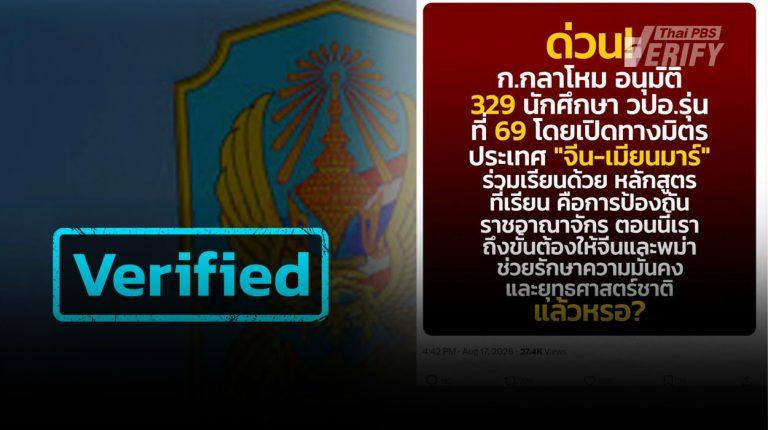
Fact-Check: Defence Ministry clarifies claims regarding Chinese and Myanmar nationals approved for NDC Class 69
What is the actual truth?
An examination of Ministry of Defence Order No. 266/69 revealed that 329 participants were approved for the 69th National Defence Course for the 2026–2027 academic year. The roster includes five international officers and officials from Indonesia, China, Myanmar, Malaysia, and India.
The enrollment of foreign nationals in the National Defence Course is not unprecedented in Class 69. Class 68 included seven international participants from Indonesia, Myanmar, Malaysia, China, Singapore, Vietnam, and Australia, while Class 67 also hosted seven from Malaysia, Cambodia, India, Indonesia, South Korea, the United Kingdom, and Vietnam. However, reports in 2025 indicated that Thailand suspended military cooperation with Cambodia—including educational exchange programs and the NDC curriculum—due to border tensions between the two nations.
Thai PBS Verify traced the origin of the report to X.
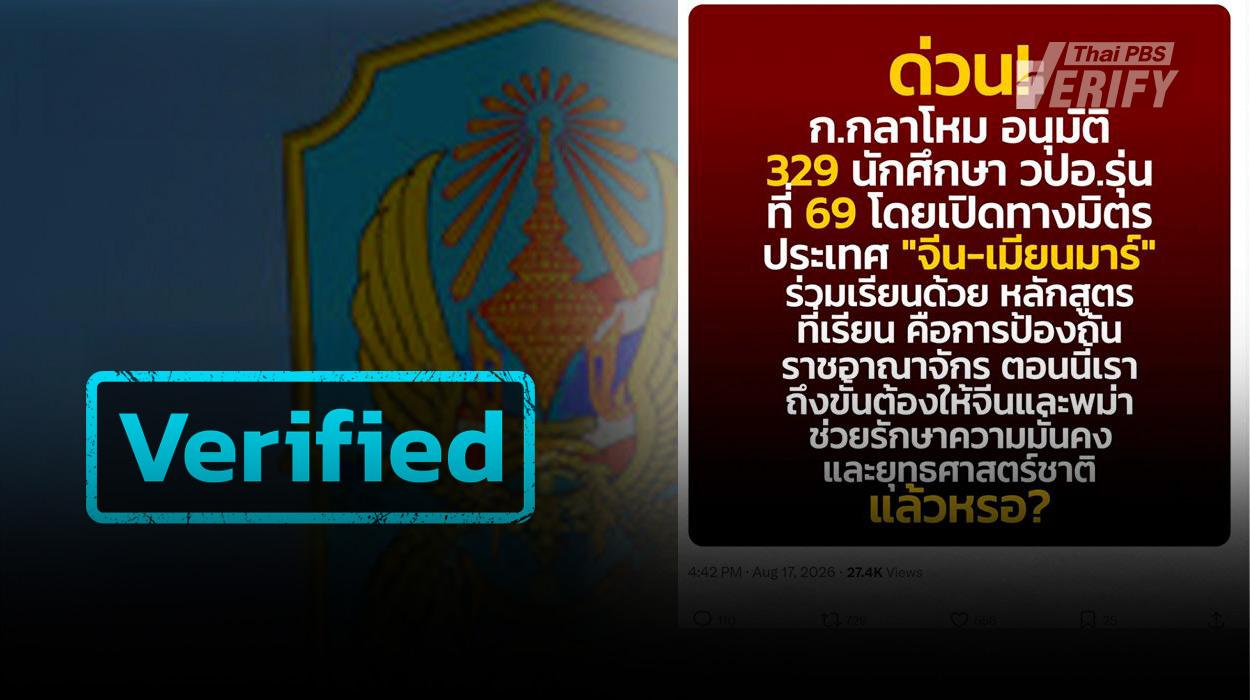
A widely shared post claimed that the Ministry of Defence approved 329 people for Class 69 of the National Defence College, pointing out that students from China and Myanmar are attending. It questioned whether welcoming both countries means giving them a role in shaping or overseeing Thailand’s national security and strategic direction.
According to the post:
The Ministry of Defence greenlit 329 attendees for NDC Class 69, paving the way for friendly nations like China and Myanmar to take part. Since this curriculum is about national defence, has it come down to letting China and Myanmar oversee our security and strategic interests?
#GreyBusiness #Burma #ArmedForces
The post reached more than 25,800 views
Roster of NDC Class 69 Reveals International Attendees
An examination of Ministry of Defence Order (Specific) No. 266/69 confirms the endorsement of 329 participants admitted to the National Defence Course (Class 69) for the academic year 2026–2027. Notably, the approved list features five foreign officers and officials from Indonesia, China, Myanmar, Malaysia, and India.
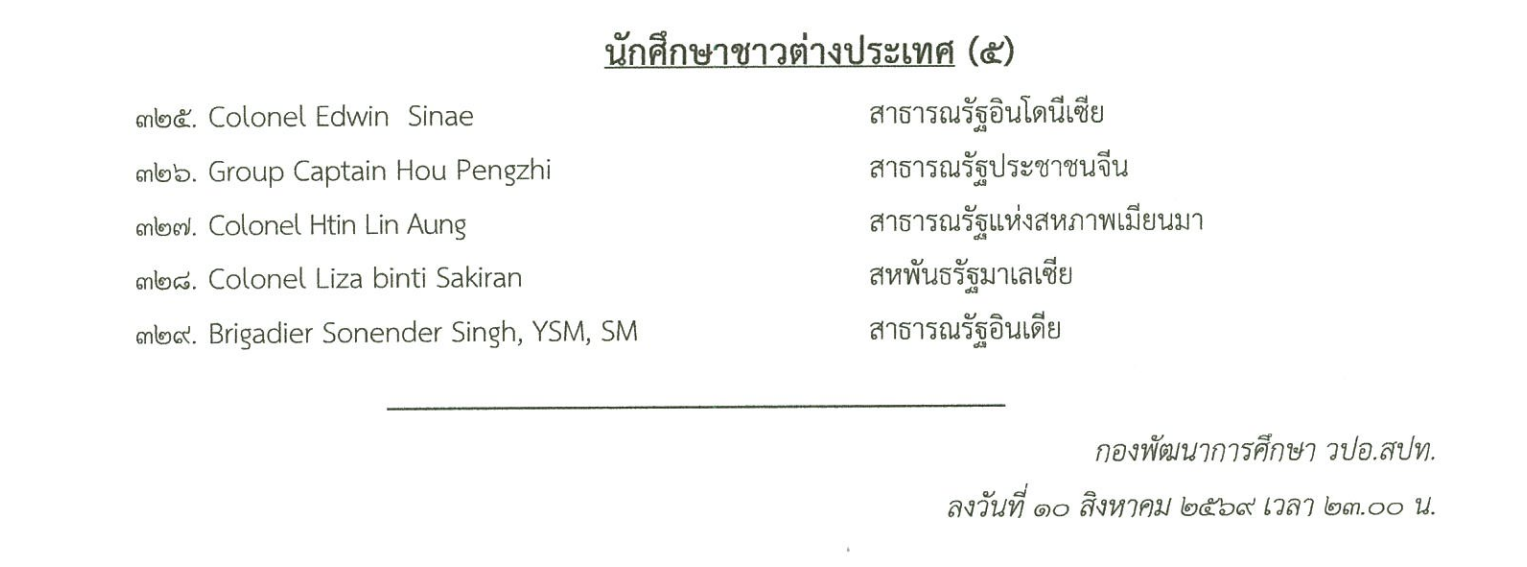
Among the 329 attendees approved for the 2026–2027 National Defence College (NDC) Class 69, five international students are on the list.
Furthermore, historical records from the 68th National Defence Course indicate the admission of seven foreign participants hailing from Indonesia, Myanmar, Malaysia, China, Singapore, Vietnam, and Australia.
For NDC Class 67, seven international participants were admitted from Malaysia, Cambodia, India, Indonesia, South Korea, the United Kingdom, and Vietnam. However, Cambodia’s quota was later revoked. In 2025, Gen. Natthapon Nakpanich, then-Deputy Defence Minister acting on behalf of the Defence Minister, stated that in response to clashes along the Thai-Cambodian border, an order was issued to suspend all military aid and bilateral cooperation with Cambodia, including ongoing educational exchange initiatives and the National Defence College (NDC) curriculum.
National Defence Course (NDC)
According to the NDC website, the course focuses on defence and national security. It brings together leaders from government, the military, the private sector, and politics to build a shared understanding of their collective role in keeping the nation secure, while preparing them to shape policy, devise strategies, and coordinate national security efforts effectively.
Admission criteria and candidate qualifications are subject to specific eligibility requirements, with designated quotas allocated across various agencies and sectors.
Records also detail the enrollment costs: 2025 figures show a per-person charge of 12,870 THB, which includes a lifetime NDC membership, uniforms, and study equipment.
Analysis: What are the strategic implications of admitting foreign participants to national security courses?
According to Assoc. Prof. Dr. Panitan Wattanayagorn, an expert in international relations and security and a former instructor at Thailand’s National Defence College, the NDC model is globally widespread. Numerous nations operate equivalent advanced security and defence institutions, often designated as National Defense Colleges or similar institutions.

Assoc. Prof. Dr. Panitan Wattanayagorn, an expert on national defence and international affairs
These courses offer holistic insights into security, economics, and social affairs to reinforce that national defence is not exclusively a military responsibility. As such, they frequently open admission to the private sector, politicians, government officials, and foreign representatives.
The inclusion of international participants often serves as a platform for exchanging knowledge and perspectives on security, strategy, and national policies, while also fostering diplomatic ties and cooperative networks. Such admissions, however, should be evaluated on a case-by-case basis under relevant agreements and regulatory criteria.
On the one hand, Dr. Panitan sees foreign enrollment as a great way to foster high-level expertise sharing and build connections that pay off in long-term cooperation. Even so, he pointed out that this should go hand-in-hand with assessing whether the budget is well spent, what real results the program delivers, and how appropriate its field trips and activities actually are.
As for worries about security leaks and secrets, Assoc. Prof. Dr. Panitan pointed out that official rules already safeguard confidential data, meaning highly classified material should never be brought into the classroom. The focus should be on vetting the sensitivity of what is taught, especially since a lot of security policy today—like general national security blueprints or southern border policies—is already open to the public as open data.
Hence, assessing the appropriateness of foreign participation requires balancing the advantages of knowledge exchange and international relations against budget efficiency and the security safeguards established for sensitive data and field activities
We need to consider that international participants bring strategic insights, combat expertise, and their own countries’ policy perspectives to share, which helps foster strong relations with us on another level. However, some segments of the public may feel the scope is too broad to yield tangible results when measured against budget cost-effectiveness.
In the long term, the key benefits may include stronger bilateral relations and greater opportunities for future collaboration. On the downside, potential risks involve budget expenditures, intelligence leaks, personal conflicts of interest, or unnecessary field visits. These are areas where caution is warranted,” said Assoc. Prof. Dr. Panitan Wattanayagorn.
Verification Process
1.Cross-checking the names with competent authorities:
Records from Ministry of Defence (Specific) Order No. 266/69 show that 329 attendees have been admitted to NDC Class 69 for the 2026–2027 academic year. The list features five international participants from Indonesia, China, Myanmar, Malaysia, and India.

Related Content