Viral Nepal-China Landslide Video Garnering Millions of Views Exposed as Recycled Footage From Russia and Japan
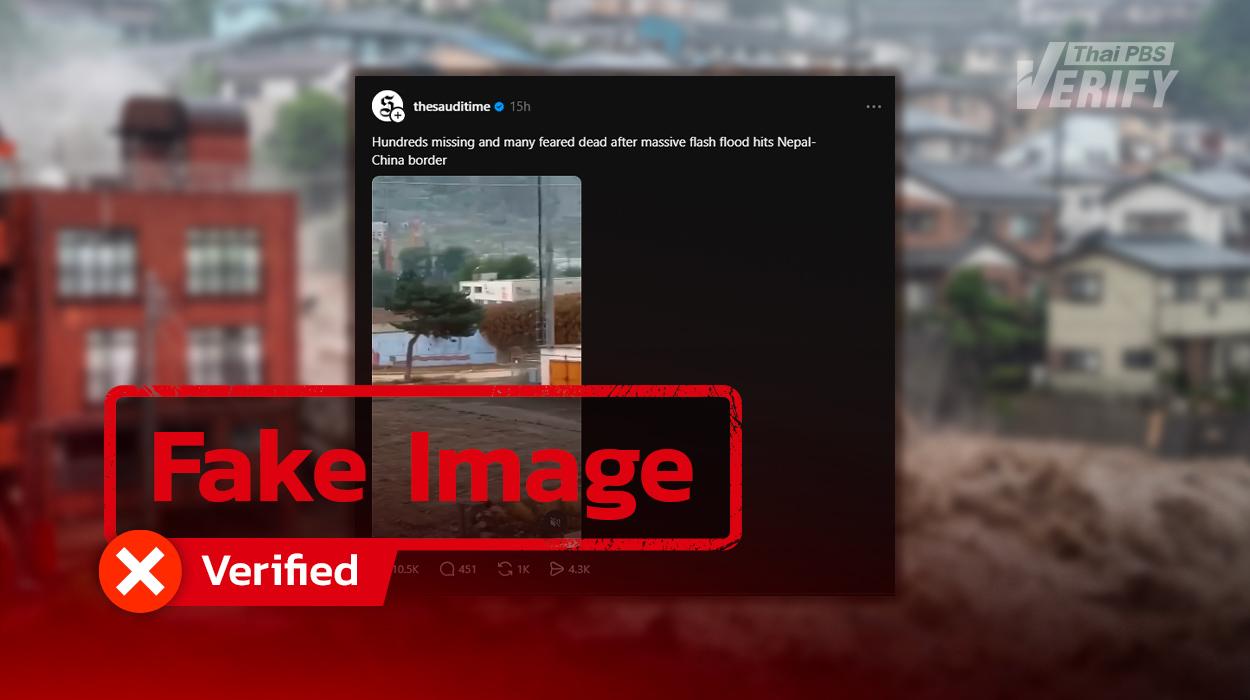
Thai PBS Verify found the source of this information from: Threads
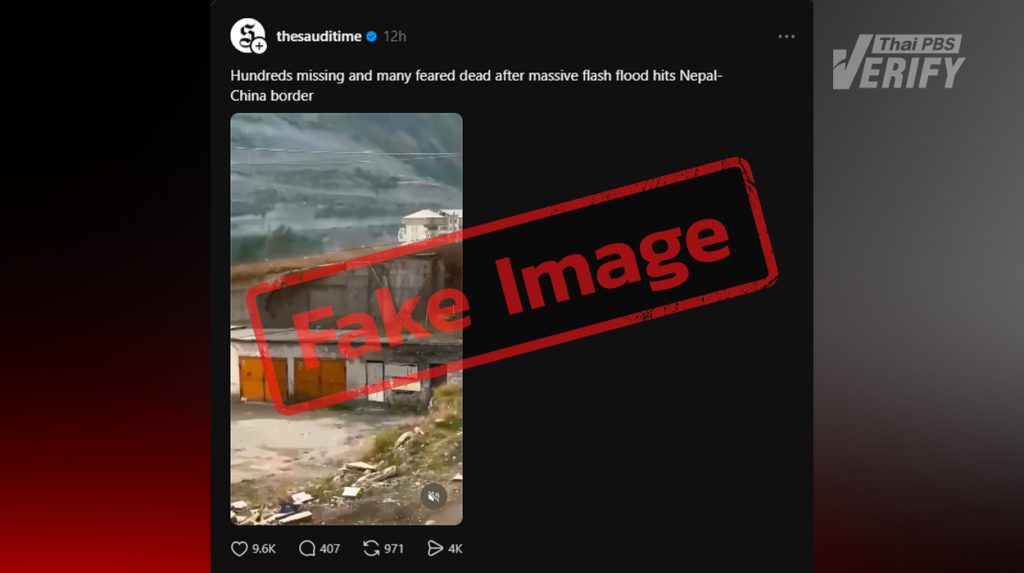
Thai PBS Verify discovered a user with the account name thesauditime on Threads who posted a video containing multiple scenes, claiming it showed massive landslides and floods hitting the Nepal-China border, along with the following message:
Hundreds missing and many feared dead after massive flash flood hits Nepal-China border
When translated using Google Translate , the text is:
Hundreds of people are missing and many more are presumed dead after massive floods swept across the Nepal-China border.
The post, published on August 27, 2026, following flash floods and landslides in Nepal and Tibet, has garnered over 1 million views.
Is the flood and landslide footage in Nepal and Tibet real?
Thai PBS Verify conducted a reverse image search using Google Lens on the clip’s opening scene and found that it matched a news report from News of Bahrain, a Bahraini media outlet. The report covered a mudslide that occurred on July 31, 2025, in the town of Tyrnyauz, located in the Kabardino-Balkarian Republic of southern Russia, where a massive torrent of mud and water slammed into residential areas.
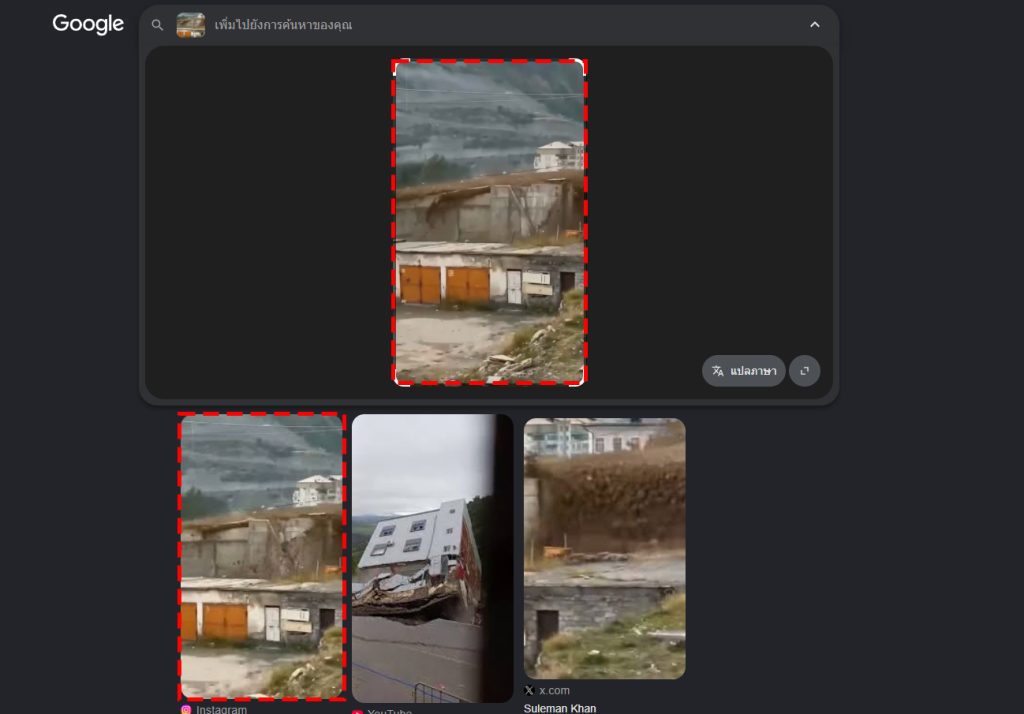
Google Lens search results
Additionally, the clip was found to have been horizontally flipped, reversing left to right, before being published. Upon restoring the image to its original orientation and searching the location via the Russian search engine Yandex Maps, the site was confirmed to indeed be in the town of Tyrnyauz. This conclusively proves that the clip has no connection to the flash floods and landslides in Nepal and Tibet whatsoever.
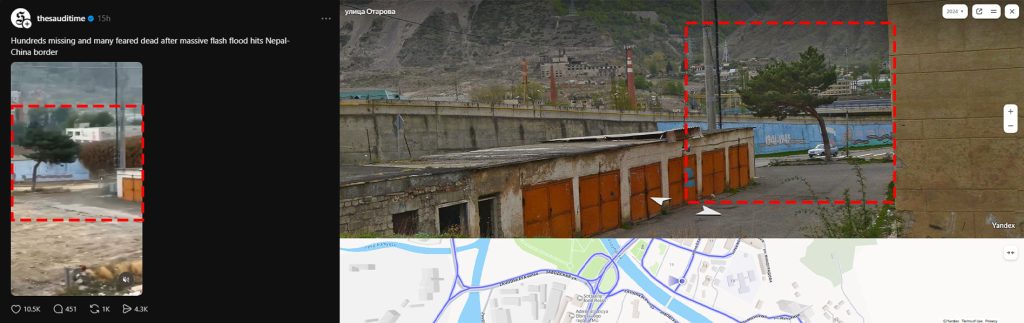
Screenshot from the fake post (left) compared with Yandex Maps imagery (right)
Map of the Incident Location
The second scene also verifies. Reverse image search revealed that this event matched footage published by Japan’s Sankei Shimbun on July 3, 2021. The clip captures a major landslide in the Japanese seaside resort town of Atami that destroyed numerous homes following days of torrential rain.
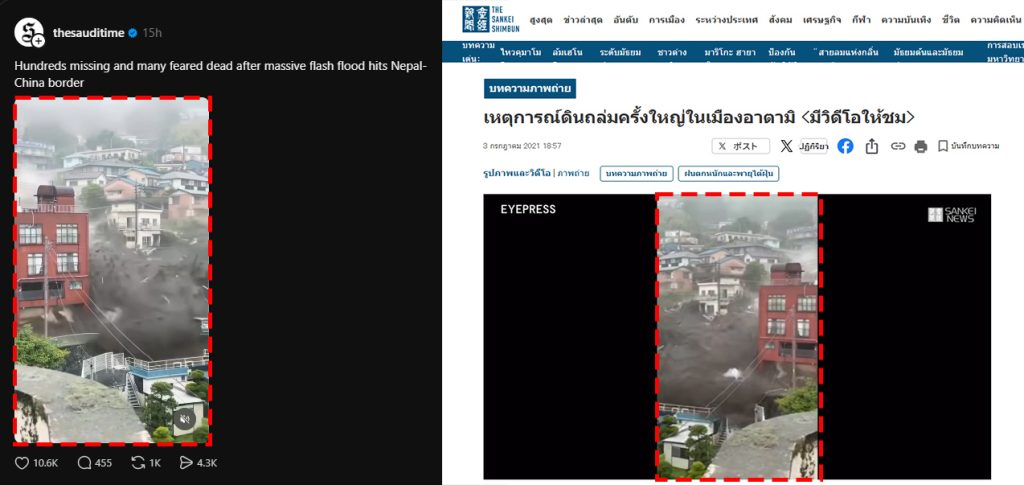
Screenshot showing the second scene in the fake post (left) compared with image from Japan’s Sankei Shimbun media (right)
Map of the Incident Location
However, we were unable to verify the sources of the other scenes included in the video.
What is the actual situation?
The Geohazards Operation Center of the Department of Mineral Resources reported that a flash flood struck the Tibet–Nepal border along the Bhote Koshi and Lhende River valleys, connecting Rasuwa District (Nepal side) with Gyirong County (Tibet side), on August 26, 2026.
The disaster was triggered when a massive avalanche of snow and boulders collapsed into the Lhende River, creating a temporary natural dam that subsequently burst, unleashing a torrential surge of sediment-laden floodwaters down the valley.
Meanwhile, the United States Geological Survey (USGS) analyzed the initial 4.4-magnitude seismic tremor, determining that it stemmed directly from the massive land and snow slide itself rather than a natural earthquake.
Emergency personnel continue to race against time in ongoing search and rescue efforts, with survivors trapped amid deep mud and wreckage. Nepal Police confirmed that the death toll has climbed to at least 162, with 64 bodies recovered in Chitwan District, a popular tourist destination.
Additionally, Nepal’s Ministry of Culture, Tourism and Civil Aviation stated that at least 579 people remain missing, including 400 foreign nationals from countries such as India, the United States, Australia, the United Kingdom, Canada, and Ukraine. A tour operator similarly confirmed that an entire tour group of 47 people, including their guide, went missing during the catastrophe.
Nepal’s Prime Minister expressed deep condolences over the tragedy and convened an emergency meeting with key agencies to address the disaster, assuring that the government is mobilizing all available resources to accelerate search and rescue operations.
Meanwhile, Chinese state media reported that at least 558 people are missing in Tibet as a result of the disaster, among whom at least 260 are foreign nationals.
Footage from the actual event
What is the truth ?
Regarding the case where a Threads account named “thesauditime” published a multi-scene video (posted on Aug 27, 2026) claiming to show a massive flood and landslide along the Nepal-China border, which surpassed 1 million views. “The fact is that the clip was fabricated through manipulative editing, splicing together old footage from different locations in the past.” The true details are as follows.
- The footage in the first scene is an incident in Russia (2025):
It is actually video of a mudslide that occurred on July 31, 2025, in the town of Tyrnyauz, Kabardino-Balkarian Republic, Russia (reported by News of Bahrain). The creator of the fake news horizontally flipped the clip from left to right to evade reverse-search detection. - The footage in the second scene is an incident in Japan (2021):
It is a clip of a massive landslide in Atami, Japan, on July 3, 2021, originally captured by Sankei Shimbun. - The actual situation on the Nepal-Tibet border (Aug 26, 2026): A real disaster did occur in the area, but it is not what is shown in the fake video. According to the Geohazards Operations Center and the USGS, an avalanche of snow and rock blocked the Lhende River, forming a temporary natural dam that subsequently burst and swept down the valley. This resulted in at least 162 fatalities in Nepal, with hundreds more missing (including foreign nationals), alongside over 558 people reported missing on the Tibet (China) side.
Verification Process
- Image Reversal & Geolocation: The news team used Google Lens to inspect frames from the first scene, unearthing leads from News of Bahrain. We discovered that the clip had been horizontally flipped (left to right). After mirroring the image back to its original orientation and cross-referencing it on Yandex Maps, the precise setting was confirmed to be the town of Tyrnyauz, Russia.
- Reverse Image Search on Scene 2: Running a reverse search on frames from the second scene revealed a direct match with news coverage and video footage from Japan’s Sankei Shimbun, documenting a separate disaster that occurred back in 2021.
- Official Data Verification: Actual incident reports were cross-checked against data from the Geohazards Operation Center (Department of Mineral Resources), the United States Geological Survey (USGS), Nepal Police, and Chinese state media to verify the true cause and casualty figures.
Impact of This Disinformation
- Making panic and fueling confusion amid a tragedy:
Passing off dramatic mudslides and landslides from other countries as current events induces severe panic among victims’ families and international tourists following the disaster closely. - Capitalizing on crisis for views (Clickbait & Engagement):
Utilizing sensational headlines paired with composite clips of terrifying scenes drove view counts past 1 million, exploiting a natural disaster as a vehicle to artificially farm social media engagement. - Distorting public understanding of natural hazards: Presenting disaster footage that fails to reflect the actual nature of the event (which stemmed from a breached natural dam) misleads the public regarding the local geological characteristics and actual pattern of destruction.
What to do with this misinformation?
- Watch out for image-flipping tricks (Horizontal Flip): Disinformation creators frequently mirror video frames horizontally from left to right to evade automated detection by search engines. If a clip appears unusually framed, try taking a screenshot, reversing it horizontally, and searching via Google Lens or Yandex.
- “Notice multi-scene compilations: Videos that rapidly stitch together disparate disaster clips featuring inconsistent environments, weather conditions, or architectural styles carry a high risk of being mishmashed edits.
- Follow updates from rescue agencies and geological bodies: Casualty figures and damage assessments should strictly rely on verified reports from official bodies like the Department of Mineral Resources, USGS, local police authorities, or local mainstream news outlets.
- Report the post: When coming across recycled disaster footage used misleadingly, join in reporting the false content (Report Fake News) on Threads to restrict the spread of misleading information across the community.