Over 10,000 Shares! Post claims mixing three COVID‑19 vaccines causes long‑term effects — experts confirm it is baseless

Thai PBS Verify found the source of Misinformation from: Facebook
Thai PBS Verify found that a Facebook user named Nisarat Khuean Thongthaeo posted about the alleged effects of COVID‑19 vaccines.
The post stated:
#Urgent… Anyone who received AstraZeneca + Sinovac + Pfizer
Women’s menstrual cycles become irregular
Allergies, itchy rashes, fatigue
Hair loss, and most recently, low platelet counts 🩸
This statement was published on 24 June 2026. After being posted, it quickly gained traction with more than 7,000 reactions and was shared over 20,000 times. Most commenters said they felt the same way as described in the post.
Does mixing COVID‑19 vaccines really cause side effects?
Thai PBS Verify searched with relevant keywords and found a report from the Center for Medical Genomics, Faculty of Medicine, Ramathibodi Hospital, Mahidol University. The page addressed side effects from mixed COVID‑19 vaccine regimens such as AstraZeneca + Moderna + Pfizer, stating:
When a person has received multiple types of COVID‑19 vaccines (e.g., AstraZeneca + Moderna + Pfizer) and later experiences various abnormal symptoms, it cannot be proven that the vaccines or the mixed regimen itself are the direct cause.
The report further noted that the World Health Organization (WHO) recognizes the practice of mixing different vaccine types. Clinical studies in several countries have found that mixed regimens show overall safety data within acceptable standards.
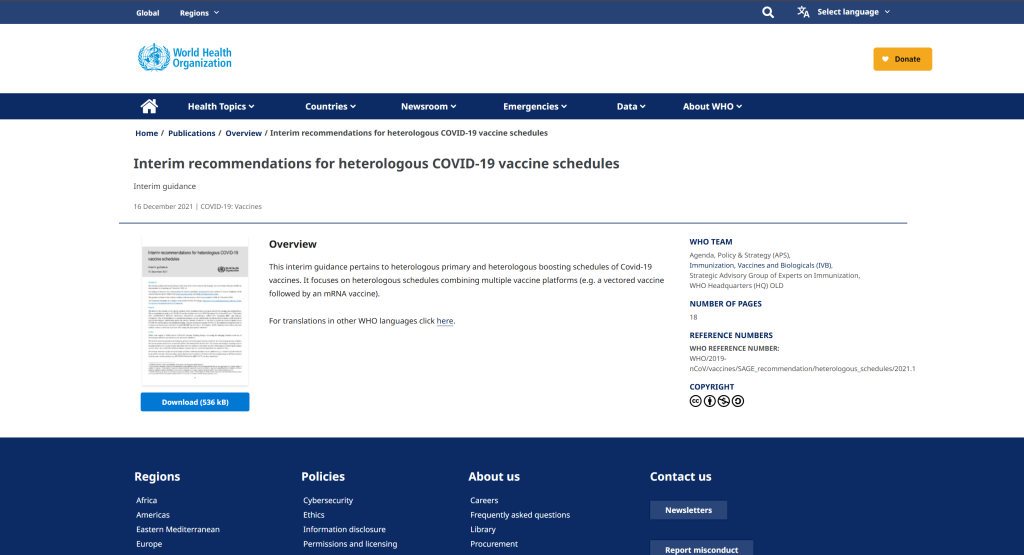
A Screenshot from the World Health Organization (WHO) website
In conclusion, the claim should not be stated or concluded definitively that all the reported symptoms (irregular menstruation, itchy rashes, fatigue, hair loss, low platelet counts) were caused by the mixed COVID‑19 vaccine regimen (AstraZeneca + Moderna + Pfizer) simply because they appeared afterward. This does not constitute medical evidence of direct causation.
Temporary menstrual changes and short‑term side effects after vaccination are considered normal occurrences. Meanwhile, low platelet counts are a medical condition that requires systematic investigation. Physicians must evaluate both the timing after vaccination and other possible health causes before determining the origin.

A Screenshot showing the Facebook page of the Center for Medical Genomics, Faculty of Medicine, Ramathibodi Hospital, Mahidol University
Experts stress that mixed COVID‑19 vaccines are not the cause of all the illnesses claimed
Prof. Dr. Wasan Chantratita, Head of the Center for Medical Genomics, Faculty of Medicine, Ramathibodi Hospital, told Thai PBS Verify that the claim about mixing three vaccines causing side effects is misleading. He explained that cases of blood clots and low platelet counts linked to the AstraZeneca vaccine did occur, but they were rare events, affecting only a small group of people, not everyone.
While most common vaccine side effects are mild and resolve on their own, the low platelet condition associated with AstraZeneca was an exception. For this reason, AstraZeneca vaccination has since been discontinued.
General side effects of COVID‑19 vaccines (regardless of brand) may include temporary menstrual irregularities, itchy rashes, fatigue in the first 1–3 days, or hair loss in some individuals.
Importantly, recipients do not experience all these symptoms together as a single set. Side effects must appear quickly, within 24–48 hours or up to 3–4 days after vaccination. If symptoms arise much later, they are not considered vaccine‑related.

Prof. Dr. Wasan Chantratita, Head of the Center for Medical Genomics, Faculty of Medicine, Ramathibodi Hospital
Difference between vaccine side effects and Long COVID
The most important difference between vaccine side effects and Long COVID is the timing of symptom onset and the duration of symptoms.
- Vaccine side effects: Symptoms must appear suddenly and quickly, usually within 24–48 hours or no later than 3–4 days after vaccination. For example, temporary fatigue in the first 1–3 days, or other symptoms, like menstrual changes, or itchy rashes.
These effects may occur in some individuals but typically resolve within a few days. Medical data show no evidence that vaccine side effects appear after a long delay following vaccination. - Long COVID: Symptoms persist for an extended period. For example, if a patient experiences ongoing fatigue over a long period, such symptoms are considered Long COVID, not side effects from vaccination.
Is vaccination still necessary today?
Prof. Dr. Wasan explained that at present, there is no longer a blanket recommendation for everyone to be vaccinated as in the past. Instead, vaccination is considered necessary and recommended only for high‑risk groups, because COVID‑19 continues to mutate. For these groups, receiving vaccines is more beneficial than not being vaccinated. Moreover, new vaccines are being developed and updated to match the latest circulating variants.
The high‑risk groups for whom vaccination is recommended include:
- Older adults (the elderly)
- Individuals with underlying health conditions, especially those with immunodeficiency, such as organ transplant recipients—this group is considered particularly in need of vaccination.
Experts confirm the claim is false—Side effects do not appear 4–5 years later
Thai PBS Verify also interviewed Dr. Anan Jongkaewwattana, virologist and Director of the Animal Health Innovation and Management Research Group at the National Center for Genetic Engineering and Biotechnology (BIOTEC), under the National Science and Technology Development Agency (NSTDA). He explained that:
The widely shared claim—that receiving three types of COVID‑19 vaccines (such as AstraZeneca + Moderna + Pfizer) would cause abnormal symptoms 4–5 years later—is entirely false and unsupported by any scientific evidence. If allergic reactions or side effects were real, they should occur shortly after vaccination. Concluding that current illnesses are the result of vaccines given 4–5 years ago is impossible, because during that time each individual has lived differently—eating various foods, taking different medications, and engaging in diverse activities. These factors cannot be controlled.

ดร.อนันต์ จงแก้ววัฒนา นักไวรัสวิทยาและผู้อำนวยการกลุ่มวิจัยนวัตกรรมสุขภาพสัตว์และการจัดการ ศูนย์พันธุวิศวกรรมและเทคโนโลยีชีวภาพแห่งชาติ (BIOTEC)
“Before any vaccine is approved by the Food and Drug Administration (FDA) and administered to large populations, it must undergo rigorous testing. Therefore, it is impossible for a vaccine to cause the exact same adverse effects across the entire population. Certain illnesses may be individual‑specific, such as underlying medical conditions or a person’s own physical state and cannot be generalized as being caused by the vaccine.”
At present, the use of older vaccines has been discontinued. In particular, the vaccines mentioned in the rumors—Sinovac, Sinopharm, and AstraZeneca—are no longer produced and are no longer available on the market. Manufacturing facilities have shifted to producing mRNA‑based vaccines instead.
At present, COVID‑19 vaccination is hardly necessary for the general population, since most people already have natural immunity from prior infection. If vaccination is truly needed (for example, in high‑risk groups with underlying conditions), physicians will use mRNA vaccines (such as Moderna) and assess vaccination on an individual basis.
“This baseless fake news, shared by anonymous accounts, is typically created to cause public panic. Those who benefit from such rumors are often groups seeking online engagement—such as sellers of dietary supplements claiming disease prevention benefits, or health insurance vendors.”
What is the truth?
- Fake information with no scientific basis: The claim that mixed COVID‑19 vaccines (AstraZeneca, Sinovac, Pfizer) would cause a large set of abnormal symptoms together (such as irregular menstruation, allergies, rashes, fatigue, hair loss, and low platelet counts) appearing 4–5 years later is “entirely false.”
- Real side effects occur immediately, not years later: Medical evidence shows that allergic reactions or vaccine side effects (if any) must appear suddenly within 24–48 hours, or no later than 3–4 days after vaccination. Recipients do not experience all of the listed symptoms together as one set. To conclude that illnesses occurring now (in 2026) are the result of vaccines given 4–5 years ago is a logical fallacy (post hoc ergo propter hoc), because the human body has been exposed to many uncontrolled factors over time—lifestyle, diet, medications, and other health conditions.
- Persistent fatigue is Long COVID, not a vaccine side effect: If a person experiences ongoing, cumulative fatigue over an extended period, medical experts identify this as Long COVID—a condition resulting from prior COVID‑19 infection, not from vaccination.
- The vaccines mentioned in the post have all been discontinued: older vaccines such as Sinovac, Sinopharm, and AstraZeneca (which once had rare reports of side effects like blood clots and low platelet counts) are no longer produced or available on the market. Manufacturing worldwide has shifted to producing updated mRNA vaccines tailored to current variants instead.
Verification Process
Cross‑checking databases and international certification: Information was verified with the Medical Genomics Center, Faculty of Medicine, Ramathibodi Hospital, Mahidol University. It was found that the World Health Organization (WHO) and global clinical studies recognize the safety of heterologous (mixed) COVID‑19 vaccination regimens as being within acceptable standards.
In‑depth interviews with experts in genetics and virology:
- Prof. Dr. Wasan Chantratita (Head of the Medical Genomics Center, Ramathibodi Hospital) confirmed that short‑term side effects, such as temporary irregular menstruation or skin rashes, may occur within the first 1–3 days and will resolve on their own. Low platelet counts, however, are an individual‑specific condition that requires systematic investigation of the cause. If symptoms appear long after vaccination, they are not considered vaccine‑related.
- Dr. Anan Jongkaewwattana (virologist, BIOTEC, NSTDA) likewise confirmed that the claim is false. Scientifically, it is impossible for a vaccine to cause identical effects across large populations after 4–5 years. All vaccines undergo rigorous testing and approval by the FDA before use. Current illnesses therefore depend on individual underlying conditions and personal health status, not on vaccines administered years earlier.
Impacts of This False Information
- Creates exaggerated panic and fear: With over 20,000 shares, many people have become unnecessarily anxious about their health without any supporting reason and have grown distrustful of the public health system.
- Harms high‑risk groups who need vaccination: This misinformation may cause target groups who currently require updated vaccines, such as the elderly and individuals with chronic illnesses or weakened immunity, to refuse vaccination. As a result, they face a significantly higher risk of severe illness or death if infected with new variants.
- Exploited for commercial gain by opportunistic groups: Such baseless fake news is often manipulated by malicious actors for business purposes, especially sellers of so‑called vaccine detox supplements or health insurance vendors, who capitalize on public fear to drive engagement and sales.
What to do with this misinformation?
- Check the poster’s background and source: Health‑related news shared by ordinary accounts or anonymous users without medical documentation should be presumed to be fake.
- Recognize the current necessity: Communicate clearly that “mass vaccination is no longer required for the general population,” since most people already have natural immunity from prior infection. Vaccination remains necessary only for high‑risk groups (608 group), where physicians will individually assess and administer mRNA vaccines.
- Differentiate symptoms rationally: If experiencing unusual physical symptoms (hair loss, fatigue, irregular menstruation), consult a doctor for proper diagnosis, such as checking for Long COVID or other underlying conditions, rather than hastily concluding they are vaccine‑related.
- Verify with fact‑checking agencies: Before sharing alarming news, submit or cross‑check the information through neutral and credible channels such as Thai PBS Verify or the Anti‑Fake News Center Thailand, to help stop the spread of misinformation.
Sources of Reference Information
Safety of Mix‑and‑Match Vaccination:
- World Health Organization (WHO): Interim statement on heterologous priming for COVID-19 vaccines https://www.who.int/…/10-08-2021-interim-statement-on…
- The BMJ: Safety of heterologous primary and booster schedules with ChAdOx1-S and BNT162b2 or mRNA-1273 vaccines https://www.bmj.com/content/378/bmj-2022-070483
Vaccines and Temporary Menstrual Changes:
- NIH (National Institutes of Health): COVID-19 vaccination and menstrual cycle characteristics: A prospective cohort study https://pmc.ncbi.nlm.nih.gov/articles/PMC10239900/
Thrombosis with Thrombocytopenia Syndrome (TTS/VITT) and Onset Timing:
- NIH / PMC: COVID‐19: Vaccine‐induced immune thrombotic thrombocytopenia https://pmc.ncbi.nlm.nih.gov/articles/PMC9538855/
- Queensland Health: Information for clinicians – thrombosis with thrombocytopenia syndrome (TTS) https://www.health.qld.gov.au/…/covid-19-vaccination…
COVID‑19 Infection and Hair Loss (Telogen Effluvium):
- CORE (Clinical Research): Hair loss following COVID-19 infection – the state of current knowledge https://www.researchgate.net/…/366059790_Hair_loss…
- GoodRx Health / ข้อมูลอ้างอิงทางการแพทย์: Can COVID-19 Cause Hair Loss? https://www.goodrx.com/conditions/covid-19/covid-hair-loss