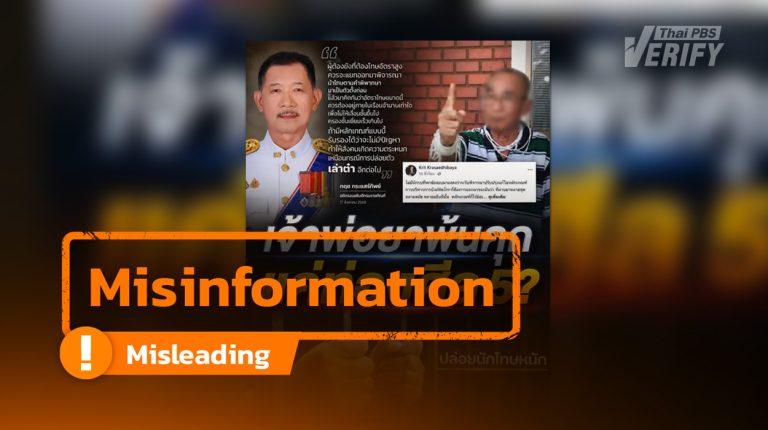
Department of Corrections Clarifies: “Reciting the Five Precepts Does Not Reduce Prison Sentences,” Emphasizing It Is Not a Criterion for Prisoner Class Promotion
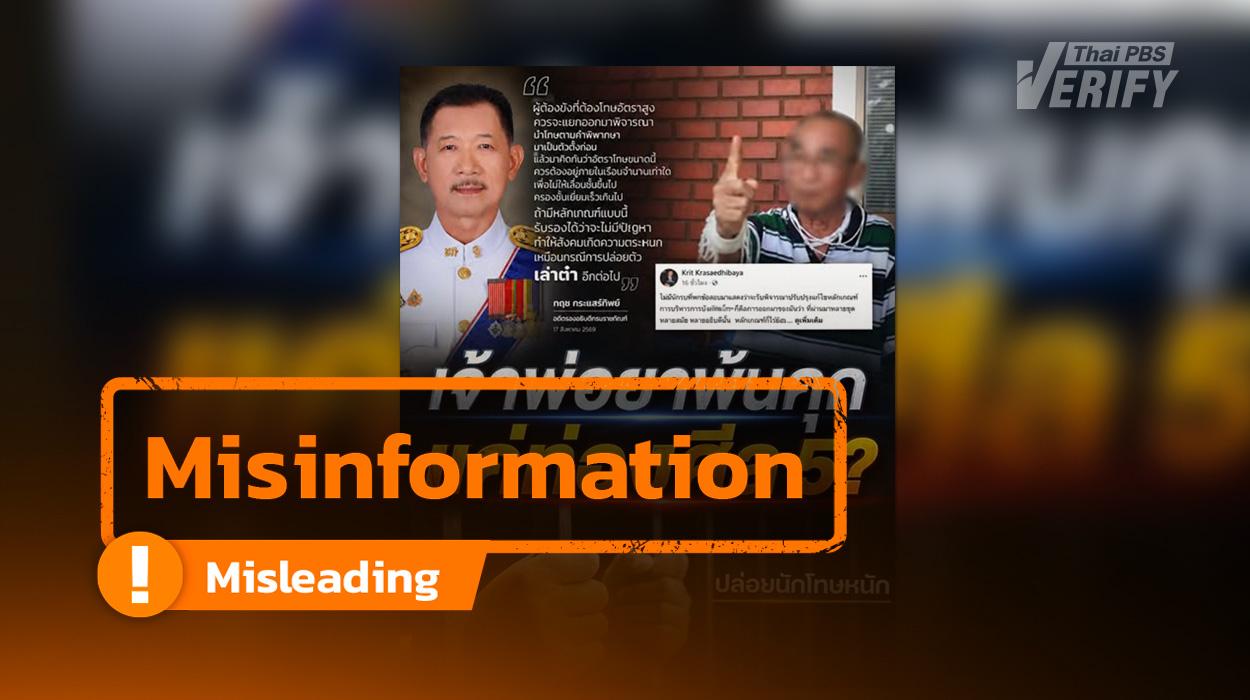
Thai PBS Verify traced the claim to its original social media source on Facebook.
What Was Claimed?
A Facebook page published a post asserting that a former senior corrections official had criticized Thailand’s prisoner promotion criteria as overly lenient, alleging that merely reciting the Five Precepts fluently could yield sentence reductions—resulting in “Lao Ta” serving just over eight years behind bars.
Thai PBS Verify identified the Facebook page Chimlang, which shared the following statement:
“The court determines the sentence. If a sentence is to be reduced, regulations should mandate prior consultation with the court. A former senior corrections official criticized pardon criteria, pointing out that reciting the ‘Five Precepts’ fluently was enough to qualify for prisoner class promotion in the case of ‘Lao Ta.’
“Lao Ta Saenli, an 85-year-old drug lord sentenced to life imprisonment, walked out of prison after his sentence was reduced to just over eight years. This prompted Krit Krasaedhibaya, former Deputy Director-General of the Department of Corrections, to question publicly whether Thailand’s criteria for promoting prisoners are excessively lenient.
“He revealed that promotion to ‘excellent class’ prisoner had practically become an automated process. In some instances, simply reciting the Five Precepts and the Five Virtues fluently was sufficient to pass. The crucial question remains: are rote memorization and genuine behavioral reform truly the same thing? How dependable is a memorization test in deciding who deserves early release?
“Krit called for a thorough overhaul of the criteria, urging that serious offenses carrying severe penalties be evaluated under separate, stringent guidelines before another Lao Ta case occurs.”
The post was published on August 18, 2026, amid public debate over whether correctional facilities exist to rehabilitate offenders or merely test rote memorization.
Sources cited in the post included Matichon, Thai PBS, and Daily News. The post garnered 946 reactions, 546 comments, and 86 shares.
How Did the “Five Precepts” Claim Originate?
A reverse image search via Google Lens revealed that the controversy stemmed from a Facebook post by Krit Krasaedhibaya, former Deputy Director-General of the Department of Corrections, concerning the department’s announcement to reform sentence execution guidelines.
His post noted that prisoner promotion has historically lacked proper alignment with the judicial intent of court rulings. For instance, a life sentence is intended to permanently segregate serious offenders from society; however, the internal prison promotion system has operated almost automatically on a six-month cycle, provided an inmate commits no disciplinary infractions and completes basic training courses—largely driven by chronic prison overcrowding and personnel shortages.
Krit added that, historically, promotion assessments were sometimes reduced to basic tests such as reciting the Five Precepts and the Five Virtues (เบญจศีล-เบญจธรรม), taking an oath, or singing the national anthem—none of which genuinely reflect meaningful behavioral transformation. Once prisoners obtained higher classifications with ease, they unlocked extensive benefits, including sentence reductions, parole eligibility, or inclusion in royal pardon decrees.
He therefore proposed that inmates convicted of severe crimes be evaluated separately, using the court-mandated sentence as a baseline to determine a strict minimum term that must be served prior to any promotion eligibility. He also urged the executive branch to exercise prudence when drafting royal pardon decrees, carefully weighing their broader societal impact to uphold royal dignity and maintain public confidence.
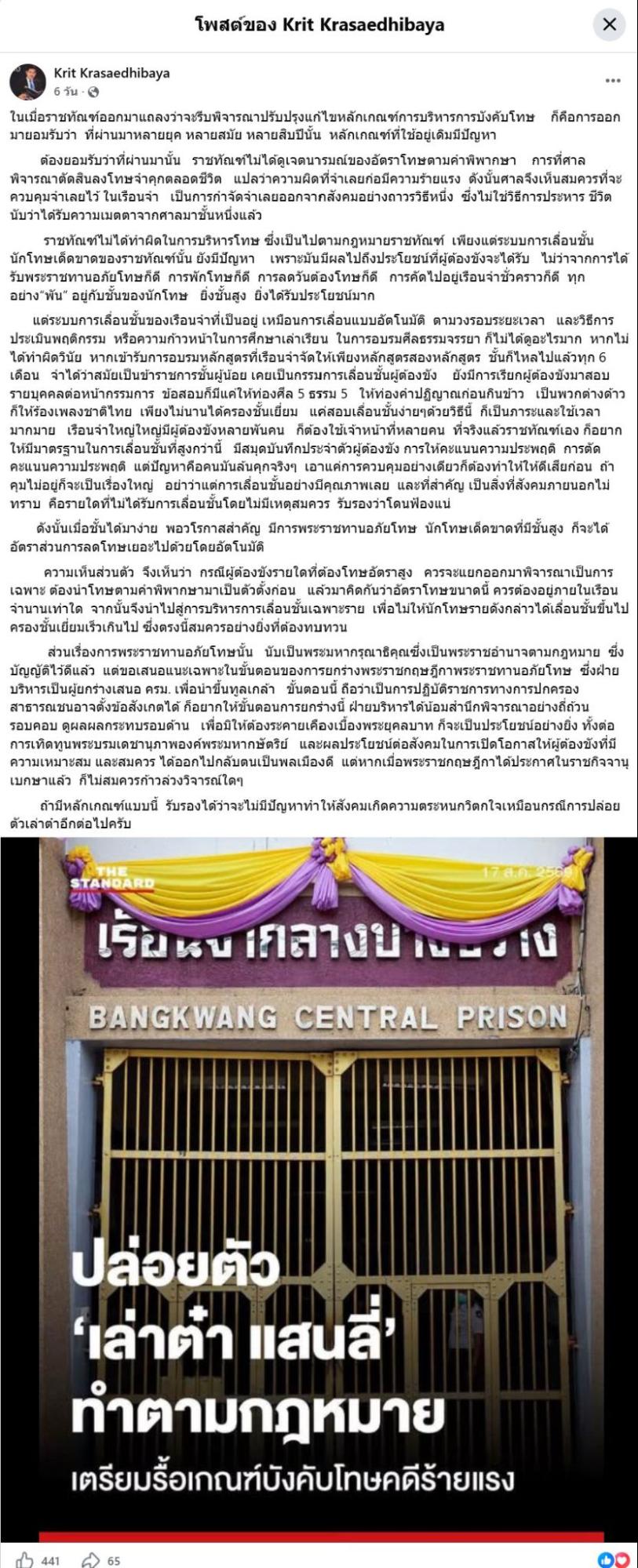
A screenshot of the Facebook post by Krit Krasaedhibaya, former Deputy Director-General of the Department of Corrections, discussing proposed reforms to sentence execution criteria for high-penalty criminal cases.
Does the Department of Corrections Have a Policy on Reciting the Five Precepts?
Thai PBS Verify checked for the keyword “reciting the Five Precepts” within the Corrections Act B.E. 2560 (2017). Sections 52 and 53, which govern inmate benefits, contain no statutory provision granting release or sentence reduction based on reciting religious precepts.
Section 52 stipulates that convicted inmates who demonstrate good conduct, diligence, educational or vocational progress, or exceptional merit may receive specified privileges, including:
- Promotion to a higher prisoner classification;
- Temporary leave not exceeding seven days;
- Sentence reductions (remission of sentence days);
- Parole; or
- Permission to undergo vocational training or study outside prison premises.
All such benefits are subject to prescribed criteria, conditions, and explicit consideration of the gravity of the underlying crime.
A review of Thailand’s initial penal statute, the Corrections Act B.E. 2479 (1936) (specifically Sections 32 and 48), likewise confirmed that no provision ever permitted sentence reductions simply for reciting religious texts.
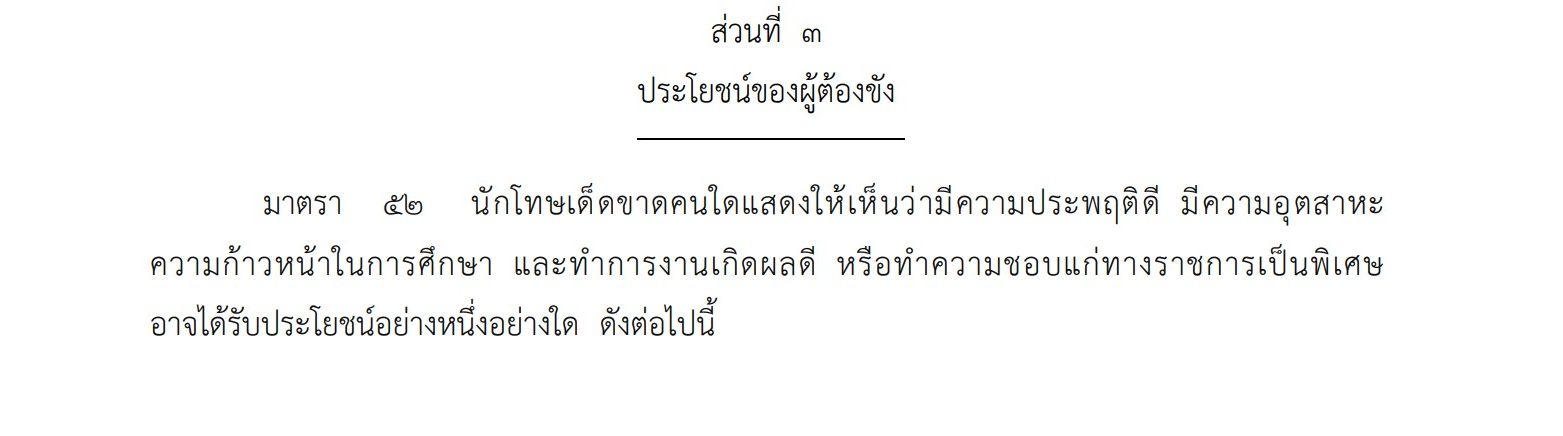
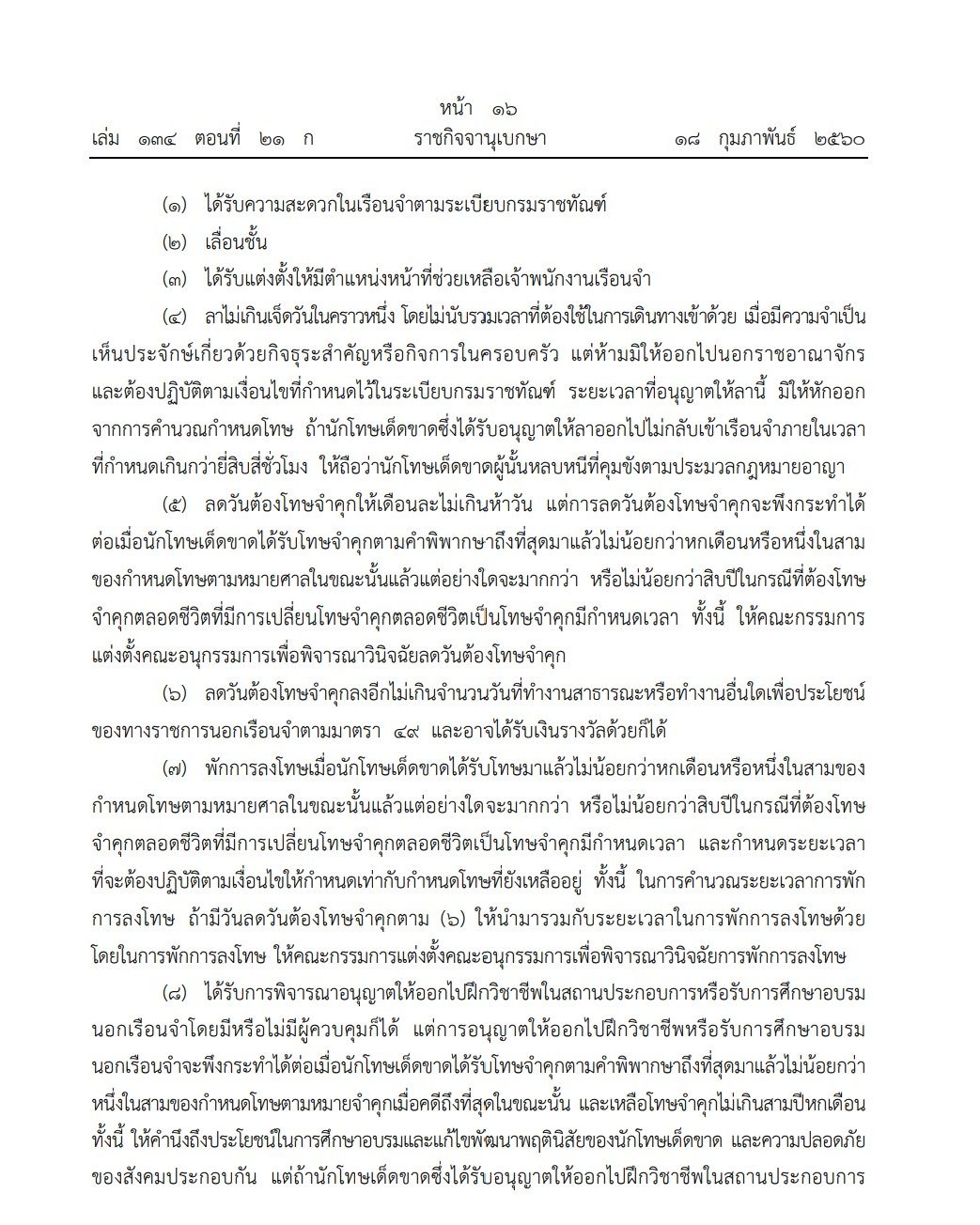
Corrections Act B.E. 2560 (2017)
In addition, the Penitentiary Act B.E. 2479 (1936), the first legislation enacted to govern the country’s correctional system, contains no provision in Sections 32 and 48 regarding the reduction of prisoners’ sentences through reciting the Five Precepts.
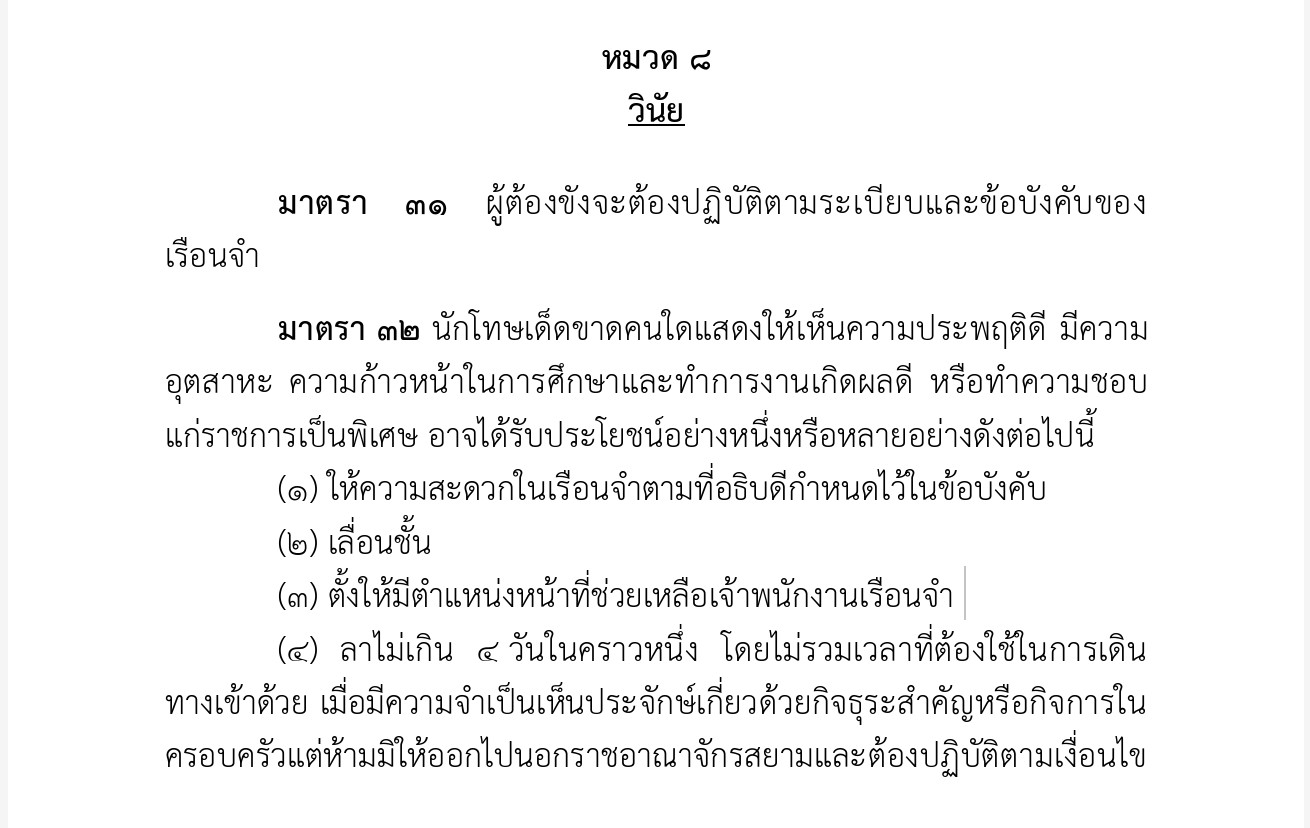
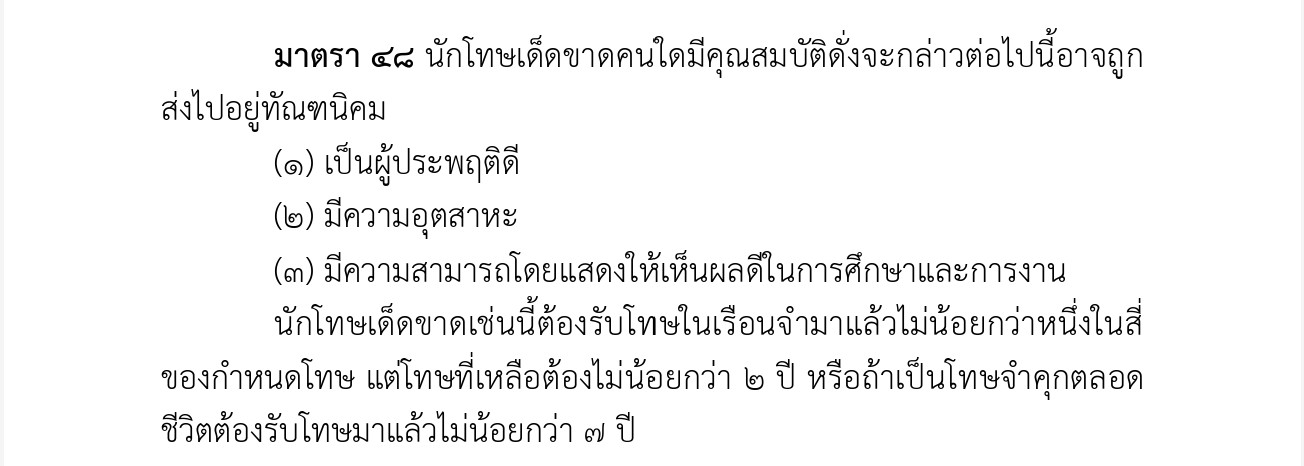
Penitentiary Act B.E. 2479 (1936)
Department of Corrections Confirms: Precept Recitation and Anthem Singing Are Not Primary Promotion Criteria
The Department of Corrections, Ministry of Justice, confirmed to the Anti-Fake News Center that inmate classification is a systematic process dependent on multiple holistic factors: personal conduct, disciplinary adherence, activity participation, rehabilitation progress, and statutory qualifications set by law and ministerial regulations.
Regarding the recitation of the Five Precepts and the singing of the national anthem, authorities clarified that these were merely past supplementary behavioral activities. They were never sole or primary statutory criteria for upgrading prisoner classes, nor are they used as such today. Modern inmate assessments focus strictly on genuine rehabilitation and disciplinary compliance.
Why Was Lao Ta Saenli’s Sentence Reduced?
The viral posts featured images of Lao Ta Saenli, an 85-year-old former drug syndicate leader convicted of conspiracy to commit serious narcotics offenses.
Court records indicate that Lao Ta was remanded in custody on October 11, 2016. On December 12, 2019, the Criminal Court handed down a final judgment sentencing him to life imprisonment and detention in lieu of a THB 2.5 million fine.
During his imprisonment, Lao Ta received six royal pardons. His life sentence was initially commuted to a 50-year fixed term, which was subsequently reduced under the provisions of successive royal pardon decrees. Because he was an elderly inmate over 70 years of age, he qualified for additional humanitarian reductions under statutory criteria:
- 1st and 2nd Pardons: 2020
- 3rd and 4th Pardons: 2021
- 5th Pardon: 2025
- 6th Pardon: 2026
Following his final royal pardon, his remaining sentence stood at 8 years, 3 months, and 28 days. Having been continuously incarcerated from October 11, 2016, until August 14, 2026—a total of 9 years, 10 months, and 8 days—he had served out his lawful term and was released in full accordance with statutory procedures.
Why Did His Release Spark Controversy?
Lao Ta’s release ignited fierce public scrutiny because an individual convicted of major narcotics offenses and sentenced to life imprisonment saw his actual time served reduced to less than a decade through successive commutations and pardons.
This ignited debate surrounding parole rules and sentence reduction policies for serious offenders, particularly elderly convicts. Pol. Lt. Gen. Rutthaphon Naowarat, Minister of Justice, acknowledged past regulatory flaws and established a special committee to reform pardon criteria moving forward. The case underscores the delicate balance between humanitarian considerations for aging inmates and society’s demand for justice and accountability.
Current Proposed Reforms to Sentence Enforcement
As of August 24, 2026, the Working Group on Reviewing and Enhancing Criminal Sentence Enforcement and Recidivism Prevention convened its second meeting of the year at the Ministry of Justice. The panel discussed draft ministerial regulations governing inmate benefits, sentence remission, and parole conditions.
Chaired by Pol. Lt. Gen. Saiphet Srisang, Adviser to the Minister of Justice, the meeting included Lt. Col. Prawut Wongsinil, Director-General of the Department of Corrections, and Pol. Capt. Surawut Rangsa-i, Deputy Director-General. Lt. Col. Prawut noted that discussions remain ongoing as draft details are finalized.
Proposals under active consideration include setting mandatory minimum prison terms before inmates convicted of severe crimes can become eligible for class promotion:
- Death Penalty: Inmates must serve a minimum of 25 years from the date of final judgment before being eligible for classification review.
- Life Imprisonment: Inmates must serve at least 20 years in actual confinement prior to promotion consideration.
- Severe, Heinous, or High-Profile Felonies (under Section 91 of the Criminal Code): Proposed minimum mandatory terms of 5, 10, or 20 years, scaled according to the severity of the offense.
These recommendations remain working drafts subject to statutory review and formal legislative approval.
Preparedness for the Forthcoming Amnesty Act
Authorities are also monitoring the corrections department’s role under the Peaceful Society Promotion Act B.E. 2569 (2026) (the Amnesty Act).
Pol. Capt. Surawut stated that the department will be responsible for compiling eligible rosters and receiving amnesty petitions from qualified inmates and their relatives. The preliminary scope covers politically motivated and protest-related cases occurring between January 1, 2005, and July 16, 2025. Implementation will commence once the Peaceful Society Promotion Committee issues official operational guidelines following its statutory inaugural meeting within 30 days of the act’s enactment.
Initial projections suggest fewer than 10,000 inmates nationwide may qualify, many of whom have multiple overlapping convictions that require case-by-case scrutiny under the upcoming regulations.
Key Takeaways: What Is the Truth?
- Precept Recitation Does Not Commute Sentences: Reciting the Five Precepts or singing the national anthem has never been a legal criterion for sentence reductions or inmate promotions. Assessments are holistic, based on discipline, behavior, and rehabilitation.
- Lao Ta’s Release Was Legal: Lao Ta Saenli served his full commuted term under six lawful royal pardon decrees and elderly-prisoner humanitarian guidelines.
- Regulatory Overhaul Is Underway: The Ministry of Justice is drafting stricter mandatory minimum terms (e.g., 20–25 years) for serious felonies before any promotion or sentence remission can be considered.
Verification Process
- Verification Using Keywords: A search for the keyword “release” in the Corrections Act B.E. 2560 (2017) found that Articles 52 and 53, concerning benefits for prisoners, contain no provision authorizing release or sentence reductions on the basis of reciting the Five Precepts. Likewise, the Corrections Act B.E. 2479 (1936) contains no provision in Articles 32 and 58 concerning sentence reductions for prisoners based on reciting the Five Precepts.
- Verification Against Official Sources: The Department of Corrections clarified through the Anti-Fake News Center that prisoner promotion is assessed holistically, taking into account conduct, discipline, and personal development. Reciting the Five Precepts was merely an activity used in the past and is not a primary condition for prisoner promotion today, contrary to the claim circulated in the news.
Impact of the False Information
- It may cause the public to misunderstand the criteria governing prisoner promotion and sentence reductions, potentially leading people to believe that reciting the Five Precepts is a condition for receiving a sentence reduction.
- It may create misconceptions about the justice system by causing people to misunderstand that sentence reductions and royal pardons must comply with applicable legal criteria and procedures.
- It may undermine public confidence in the Department of Corrections by raising doubts about the process for considering prisoners’ rights and benefits.
- It may create misunderstandings regarding the Lao Ta Saenli case, potentially leading the public to believe that his release resulted from reciting the Five Precepts, when in fact he received royal pardons in accordance with established criteria.
- It may increase social disagreement and criticism, particularly concerning the appropriateness and fairness of sentence reductions for prisoners.
- It may contribute to the widespread circulation of inaccurate information. If people share such claims without checking their sources, misinformation may spread and become increasingly difficult to correct.
What to do with this misinformation?
- Check whether the information is current. Government agencies’ criteria and regulations may have changed since the practices described were in use.
- Distinguish between an “activity” and a “criterion.” Reciting the Five Precepts or singing the national anthem may have been activities used in the past, but this does not mean that they are current conditions for sentence reductions or prisoner promotion.
- Do not jump to conclusions based on a single individual’s case. A prisoner’s release or sentence reduction may involve multiple criteria and does not necessarily result from any one particular activity.
- Verify information directly with the responsible agency. For issues concerning laws, prisoners’ rights, and sentence-reduction criteria, information should be checked against the Department of Corrections or Ministry of Justice.
- Be cautious of headlines or statements presented without context, such as “Reciting the Five Precepts leads to a sentence reduction,” because they may take a practice used in the past and make it appear to be a rule currently in force.